“Each heart knows its own sorrow, and no one else can fully share its joy.” (Proverbs 14:10 (NLT))
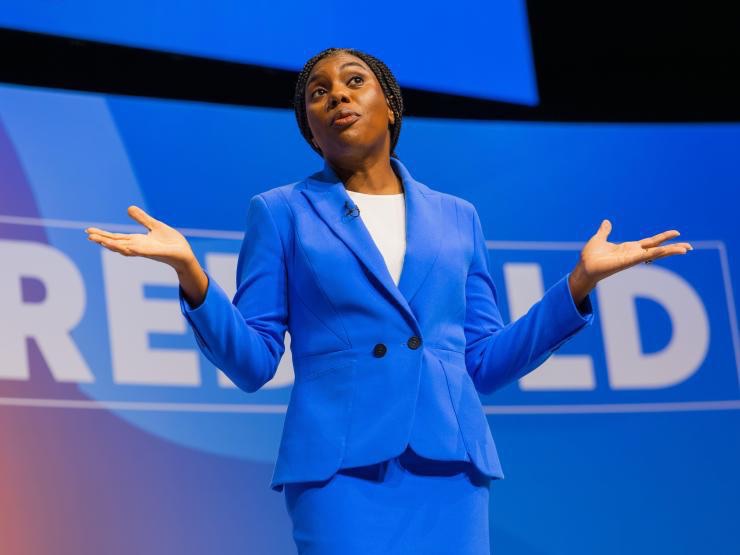
Kemi Badenoch, who spent her formative years in Nigeria, has made remarks referencing how Nigeria treated her, and how she interpreted those experiences. That is her story, personal, lived, and valid. We may not agree with her perspective or her politics, but we cannot discount her truth.
In law, testimony based on personal knowledge is admissible as evidence. Her words fall squarely within this rule. No legal brilliance can invalidate a person’s lived experience. Her narrative is not a distraction; it is a thread in the fabric of global power dynamics, a signal from the margins of state failure and personal resilience.
There is more to her story. There is an agenda in the foundation. She is a big-picture woman. She knows her story. She tells her story. And she knows why she is telling it. As an agenda thinker, she is not speaking at random. She is not merely reacting emotionally. She is communicating intentionally, with purpose, and to a specific base. As an agenda-thinker exploring the world and raising a son, I understand that. I do not say this to endorse her conclusions or her agenda. I say this because it is important to recognize when a person is operating from a place of thought-out intention.
And that’s the point: life is about agenda, not emotion, not blind patriotism, not nostalgic allegiance. Every person has the right to their own story, and to the agenda that emerges from it. And while we can disagree with the agenda, we must not invalidate the experience that gave rise to it.
Kemi’s experience mirrors that of many Nigerians, scientists, educators, athletes, inventors, artists, entertainers, and social scientists, whose homeland owed them a duty, not a favour, to nurture their God-given potential. Yet, by systemic design, Nigeria failed them. These individuals found wings elsewhere, in nations that understood that patriotism is not demanded; it is cultivated.
Now don’t get me wrong, some have pushed through in Nigeria. But at what cost to their souls, and to the rest of us? And is that success replicable? Is there a system in place to ensure that brilliance is not the exception, but the norm? The character of a nation cannot be judged by the accidental success of a few, but by the enabling environment it provides for all to thrive.
Patriotism, after all, means love for one’s nation. The operative word is “one’s.” It implies ownership, stakeholdership, a sense of belonging and a stake in the outcome. It means access, real, equitable access to opportunity, so every citizen can crawl, walk, and fly. And if some fail, let it be on their own terms, not because the system rigged the flight path.
But when the state abdicates its responsibility to provide welfare and security, when it breaks the fundamental social contract, patriotism becomes a hard sell. Except, of course, anyone now wants to argue that Nigeria is an egalitarian society or even on its way there?
When John F. Kennedy famously said, “Ask not what your country can do for you, ask what you can do for your country,” the unspoken premise was this: America had already shown herself faithful to her part of the bargain. She had earned the right to ask.
I was born in Nigeria 55 years ago. My umbilical cord was buried at LUTH, Idi-Araba, Lagos. I believe, as Acts 17:26 declares, “From one man he made all the nations, that they should inhabit the whole earth; and he marked out their appointed times in history and the boundaries of their lands.” I am Nigerian by divine appointment. That is why I care—why I speak, why I participate, and why I feel deep sorrow over the avoidable, weaponized underdevelopment of this country.
I love my nation enough not to romanticize its current mediocrity. No nation is perfect, and none ever will be. But there are baseline indicators of statehood, education, healthcare, security, equity, which Nigeria has continued to neglect, not by error, but by design.
Those who deny us healthcare know its value, they seek it abroad.
Those who doom our children to educational failure leaving nearly 20 million out of school, and many more in a 40-year learning gap, send their children to elite institutions overseas.
Those who withhold public security make private arrangements or assign public police to personal duties.
This is not ignorance. It is willful, wanton sabotage, well-dressed, well-spoken, and smiling.
I am a patriotic Nigerian. And in the lucid, legendary words of Dele Farotimi, “Nigeria is an unborn nation.” For those of us who see this truth, it is a labour we must not abandon. It is a sacred, peaceful struggle, to midwife a nation where justice is not the privilege of a few, but the inheritance of all.
This is what I teach my son.
This is the patriotism I model.
Not a blind celebration of Nigeria just because it is our place of birth, but a deep, relentless yearning to see Nigeria become a nation worthy of celebration.
The question is not whether Nigeria is our home. The real question is: Is Nigeria becoming the nation of our dreams? That question is for those who understand nationhood and dare to dream it for Nigeria
Let us focus on that, not on demonizing a woman for telling her story.
Each of us has a Nigerian story: the good, the bad, and the ugly, in whatever proportion. And we have the right to tell it. It is valid. It is protected. It is freedom of expression.
Hers just happened to find a mic.
And for those who struggle with this, remember history:
🔹 Frantz Fanon, born in the French Caribbean, turned against France in solidarity with the Algerian people. His conscience, ideology and agenda demanded it, and he acted.
🔹 Nelson Mandela called for sanctions against his own country during apartheid, not because he hated South Africa, but because he loved it enough to want it reborn.
🔹 Ken Saro-Wiwa stood up for Ogoni land, and took Nigeria before the world. He did not do it because he hated Nigeria, but because justice demanded it.
Each of them, like Kemi, operated from an agenda. Their stories shaped their choices. And whether we agree with their politics or not, we must acknowledge: their pain, their passion, and their pursuit were real.
Do have an INSPIRED Week ahead with the family.
 Taiwo AKINLAMI