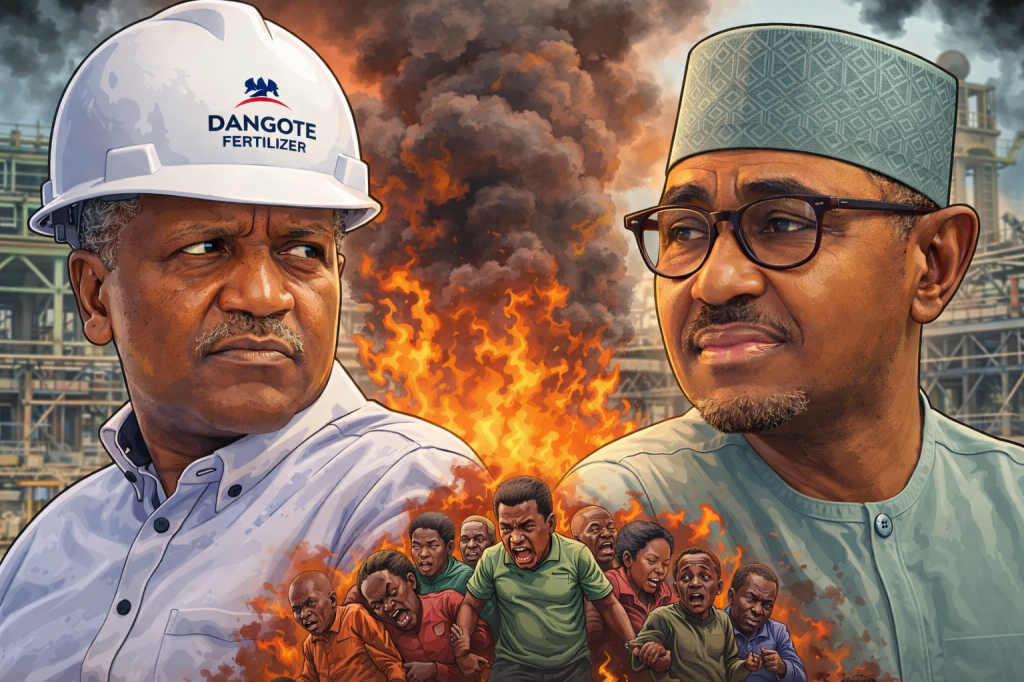
Aliko Dangote is not new to conflict with Nigeria’s petroleum regulators. Since his refinery came onstream, friction has been public, persistent, and increasingly consequential.
But the latest confrontation feels different, sharper in tone, wider in implication, and closer to the core question Nigerians keep asking: who truly governs the downstream value chain, the state, or the interests that have captured it?
Two thoughts are unavoidable.
First, it confirms a system no longer at ease with itself, an assertion many have made for years. Nigeria built a monstrous, anti-people but pro–political class model of governance, one that ran its own institutions into the ground: Nigerian Airways, NITEL, water works, hospitals, schools, and the social utilities meant to provide basic dignity. This is a country where even the celebrated genius of Richard Branson could not breathe when he tried his hand at a national carrier. Now, when Dangote, widely seen as one of the system’s biggest beneficiaries, begins to carry the placard of protest, it suggests a structure turning on itself, as though afflicted by social lupus or multiple sclerosis.
The Yoruba warning rings loudly here: “tí ìyà ò bá ti kárí, kò sẹ́gbọ́n nú”, until suffering becomes collective and undeniable, justice remains a hard sell. What was long dismissed as “industry politics” is starting to look like a national test of whether institutions can withstand pressure when the stakes are no longer abstract.
Second, motives can be debated, but facts must be examined. Some will argue Dangote is fighting for dominance, seeking to extend into oil and gas the monopoly he is accused of building across other sectors. That argument may be made. But it does not excuse the country from interrogating the claims now on the table. A questionable motive does not automatically invalidate an allegation; it raises the urgency for evidence.
Apostle Paul once observed that some preached to advance truth while others preached to cause trouble for him, yet the message still demanded attention. That is the point here. Whatever Dangote’s interests, Nigerians cannot treat these claims as mere theatre. If the allegations are false, let the regulator rebut them with verifiable records. If they are true, let the system respond with speed, transparency, and clarity.
Because whether we like it or not, if Dangote and the regulators are elephants, the Nigerian people are the grass, and we are the ones being trampled. This is precisely the moment to ask questions, without fatigue and without fear.
Silence, delay, or evasive counter-narratives will only deepen the public’s conclusion that the system protects itself, not the citizen.
Here, in substance, are the central claims Dangote has put before the public, claims he presented as grounds for federal investigation:
✅Personal corruption allegation: Dangote alleged that Farouk Ahmed, CEO of the Nigerian Midstream and Downstream Petroleum Regulatory Authority (NMDPRA), spent about $5 million over six years on Swiss secondary school fees for four children, and demanded an immediate probe into the source of the funds. He also said he would pursue disclosure of payment records, including legal action if the allegation is denied, framing it as emblematic of the extravagant lifestyle of senior public officials amid widespread hardship.
✅Economic sabotage allegation: He accused the NMDPRA leadership of undermining local refining by allegedly colluding with international traders and issuing import licenses totaling 7.5 billion liters for Q1 2026, despite his refinery’s claimed capacity to meet national demand, describing entrenched import interests as a “mafia.”
✅Market intervention and counter-pressure: Amid the dispute, Dangote announced a price move: a refinery gantry cut to N699/L and a pump price of no more than N740/L, starting Tuesday at MRS stations in Lagos. He argued locally refined “straight-run” fuel is superior to imported blends, reduced the minimum purchase threshold to 500,000 liters, and cited CNG trucks as part of widening access and pushing prices downward.
This is now bigger than Dangote. It is bigger than the regulator. It is about whether Nigeria can run a modern energy economy where rules are transparent, procurement is accountable, and regulators answer to law, not to networks.
If Dangote’s allegations are spurious, the country deserves proof. If they are credible, the country deserves consequences. Either way, the moment demands something Nigeria rarely gets in full measure: a clean, public, evidence-driven reckoning.
Do have an INSPIRED rest of the week with the family.
 Taiwo AKINLAMI