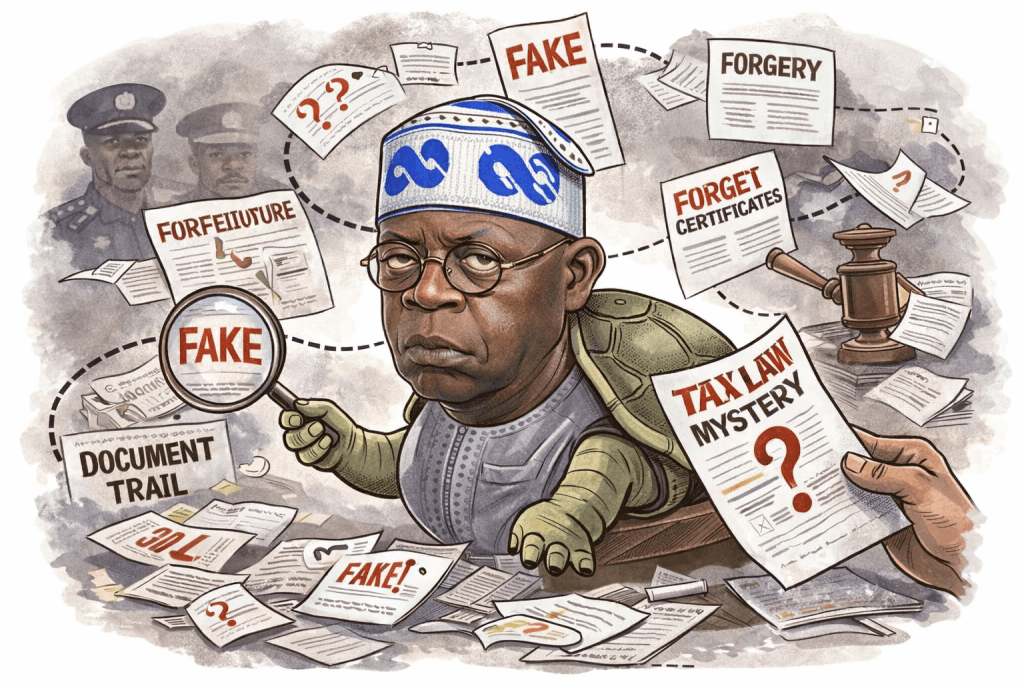
I suspect the government wants us to focus narrowly on the alleged discrepancies between what was passed, what was assented to, and what was printed, so we will miss the larger moral burden: the insistence on imposing yet another tax regime on a people already strained by hardship, while government discipline and restraint remain largely unconvincing to many citizens.
But this moment is a double-edged sword. Even if distraction is the intention, the irony is that it exposes something deeper: character. It highlights a governance culture many Nigerians increasingly describe as the culture of “edits”, a pattern of contested narratives, disputed documents, and recurring allegations that weaken trust.
There is a Yoruba warning for this kind of pattern: when a community begins to call you a thief, you do not strengthen suspicion by behaving in ways that look like theft. As the saying goes: “Wọ́n pè é ní yàn lòlé; ó tún ń gbé ọmọ ewurẹ́ jọ.” (They accuse you of theft, yet you are found mingling with the goat’s child, as if inviting the accusation to persist.)
Naming a pattern without calling names
Yoruba wisdom names patterns without necessarily naming persons. When we say “Ọ̀rò gbọ̀gbo kì í se lórí alábàhùn,” we mean the tortoise (Ìjàpá), the symbol of recurring complication, keeps showing up at the centre of messy controversies, again and again, until people begin to suspect that the problem is not merely the controversy, but the recurring actor or the recurring culture behind it.
That proverb is now echoing in Nigeria’s public space for one reason: the repeated appearance of forgery-related allegations, some established, some unresolved, some fiercely contested around the Tinubu political ecosystem.
And it raises a hard national question, framed by another proverb: the fruit rarely falls far from the tree. When the same kind of controversy keeps recurring, certificates here, affidavits there, forfeiture narratives elsewhere, electoral glitches in between then similar accusations re-emerge around ministers, party actors, and now even the integrity of a national law. Nigeria must ask: what exactly is going on?
Because a country cannot live permanently inside allegations. Allegations may be unproven, but repeated allegations still do damage. They weaken confidence, undermine legitimacy, and replace governance with suspicion.
The burden of repetition: why this is no longer “just politics”
Some claims remain allegations. Some have been contested. Some have been rejected by defenders. Some have produced legal consequences in other political contexts. But the deeper issue is not any single claim; it is the persistence of the theme: why does it keep hovering?
Since Tinubu emerged in politics since 1999, Nigeria has witnessed recurring public disputes involving:
✅Educational credentials and related documentation (allegations, rebuttals, litigation, commentary);
✅Alleged U.S. forfeiture narratives linked to proceeds of drugs (raised in public debate and interpreted differently by supporters and critics);
✅Certificate/document controversies involving political allies or figures within the broader ruling ecosystem (some litigated, some not); and
✅Most alarming of all: a current allegation touching the core of state legitimacy, the integrity of a signed national law.
That last point is another turning point, another challenge.
The tax-law controversy: when the “paper” becomes the problem
The present dispute over Nigeria’s tax law has been framed in public conversation as an allegation that what was passed is not what was published, that somewhere between the National Assembly, the Presidency, and the Government Printer, the “final text” became contested.
If this allegation is false, it must be disproved transparently.
If it is true, it is an institutional scandal of the highest order, perhaps the most dangerous expression of what people casually call “the Nigerian factor.”
Because this is not about one person’s certificate. This is about whether Nigerians can trust the chain of custody of laws, whether the written word of the Republic can be relied upon.
A state collapses quietly when citizens no longer know what to believe:
✅Which version is law?
✅Which text governs business, compliance, and enforcement?
✅Who is accountable for custodianship?
✅How many “hands” can touch a national document before it becomes something else?
Why it keeps hovering: the “trust deficit” Nigeria refuses to cure
This is where Nigerians must think beyond personalities. Even if you love or hate the President, the larger question remains: why do our institutions repeatedly allow credibility to leak?
When the same accusation keeps returning, it usually signals one of three things:
- Weak institutional custody
Nigeria’s document handling, from nominations to elections to legislation, often lacks visible, auditable chain-of-custody systems that ordinary citizens can verify. - A political culture that treats optics as governance
When governance is reduced to “presentation,” the country becomes addicted to edits: edited narratives, edited records, edited realities. - A low-consequence environment
Where allegations are not investigated transparently and concluded decisively, suspicion does not die, it multiplies. Nigerians stop debating policy and start debating authenticity.
This is why the phrase “government by forgery” keeps surfacing. The ecosystem keeps producing the same kind of smoke. And where smoke becomes habitual, citizens begin to ask whether fire is being managed, or merely denied.
The question Nigeria must ask (without fear or worship)
So let us ask plainly, without hysteria and without propaganda:
✅Why do allegations of forgery keep clustering around the Tinubu’s political ecosystem?
✅Why do document controversies keep appearing at the top, then reappearing around allies, appointees, and party actors?
✅Why does the country repeatedly end up in arguments about “papers” instead of progress?
✅Now that the controversy has touched a national law, what does this imply about institutional discipline?
If the fruit does not fall far from the tree, then Nigeria must examine the tree not only the fruit.
What Nigeria should learn and what Nigeria should demand now
Nigeria should stop settling for reassurance and start demanding proof systems.
If the tax-law controversy is to become a turning point rather than another episode, the following must happen immediately and publicly:
- Publish all versions side-by-side
The “as-passed” National Assembly copy, the harmonised version, the “as-transmitted” copy for assent, the “as-assented” signed text, and the gazetted text, so the public can compare. - Independent, transparent text verification
Not partisan statements. Not media spins. A forensic comparison supervised transparently. - Immutable version control for legislation
Time-stamped digital custody from committee stage to gazette publication, so “mystery edits” become structurally difficult. - Consequences where wrongdoing is proven
No true democracy survives when credibility failures produce no accountability.
Closing
I am concerned, as a Nigerian, not because I want a political winner, but because I want a trustworthy state. Allegations, whether proven or not become a national disease when they keep repeating around one ecosystem. And now that the controversy has reached the integrity of a national law, Nigeria must decide whether it wants to remain a country of “edits,” or become a country of verifiable records.
Ọ̀rò gbọ̀gbo kì í se lórí alábàhùn.
When the tortoise keeps returning to the centre of messy controversies, a wise people stop shouting and start demanding what ends controversy permanently: clean processes, auditable custody, and provable truth.
‘Enjoy you weekend’ in his words, not necessarily his deeds.
‘If you do not get it, forget about it,’ as the saying goes.
 Taiwo AKINLAMI