“Alárù tó ń jẹ̀ búrẹ́dì, awo orí ẹ̀ ló ń jẹ́ tí kò mọ̀.” Tunji Oyelana
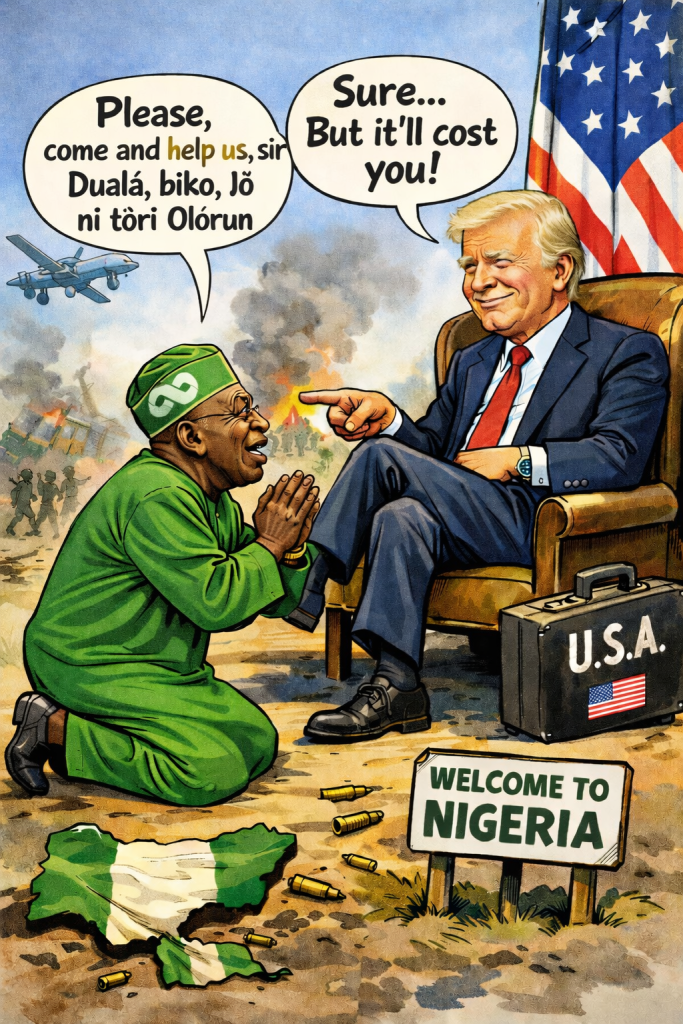
We were having a small family gathering on Christmas Day when the news filtered in: the United States of America had carried out an airstrike in Nigeria. The stated purpose was to wipe out terrorist groups that have terrorised communities in the northern part of the country.
This news came against a grim backdrop. Two days before Christmas, five people were killed in Benue State. On Christmas Eve, another attack claimed lives and left many injured. Against this context, the airstrike initially appeared, to some, justified.
I also recalled that the President of the United States had earlier spoken about the possibility of a military intervention to stop what he described as Christian genocide and, on the strength of the available facts, one can understand the basis for such conclusion, even though other citizens, including non-Christians, are also being killed and left defenceless. It is further evidence that the welfare and security of the people, government’s primary responsibility has collapsed.
My immediate concern was simple but profound: Was the Nigerian government aware?
When the possibility of intervention was first mentioned, it did not appear to have been in consultation with Nigeria. Later that day, reports emerged that the Nigerian government said it was aware of the move. In that sense, the United States was responding to our SOS, and one can hardly fault them for answering a cry of helplessness.
That was when my real fear began.
I went to bed troubled and woke up deeply afraid, genuinely afraid.
My fear is this: I hope Nigeria has not opened a dangerous flank. History teaches us that when a sovereign nation consents to foreign military intervention, particularly where its leaders have not demonstrated sincerity and altruism in confronting their own problem, but are instead chasing the shadows of propaganda and subterfuge, denying the reality of a pogrom, the consequences can snowball far beyond the original justification.
Nigeria is supposed to be a sovereign nation. Nigeria has its own military. Nigeria recently supported another African country to quell a coup. Yet here we are, in 2025, tacitly or explicitly agreeing to external military intervention to solve our internal security problem.
What does that mean?
It means that the so-called Giant of Africa has admitted that it cannot govern itself.
It is, in effect, a vote of no confidence cast by the government in itself.
The Commander-in-Chief of the Armed Forces is, by this action, saying that the enormous powers supposedly conferred on him by the Constitution are insufficient to guarantee the security of the Nigerian people. That is the unavoidable implication.
Once you open that door, you lose control of how far it swings.
Those who understand international politics know this: foreign military intervention rarely ends where it begins. It can expand, mutate, and assume dimensions far beyond the original mandate. In extreme cases, it threatens not just security operations, but the very stability and continuity of the state that invited it. In the end, it may consume the nation itself, leading to the most dreaded refugee crisis the world has not seen in a long time.
Where would over 200 million Nigerians go for succour and refuge if our nation were to finally collapse? And when that happens, it will not be the people in government who suffer first. They would be the first to leave. It should not surprise us to say that many of them have already designed, perfected, and funded their escape plans.
Yet the signal we have sent to the world is clear: we are weak.
But no external power can solve our problems for us. No external nation has ever secured the destiny of another. That responsibility belongs to the citizens. And even if we assume without conceding, that external forces can help, would they sustain it? Did the United States not eventually leave Afghanistan and Iraq?
I struggle to understand how a nation of over 200 million people, the largest Black nation on earth, one that once boasted the largest economy in Africa has been unable to resolve its insecurity challenges since 2009, and now appears unable even to insist on handling them internally.
Why could Nigeria not simply say: “We appreciate your concern. We will redouble our efforts”?
This brings me back to a conversation I once had with my friend and brother. Dele Farotimi: You can force yourself into government, but you cannot force yourself to govern. His response was profound: “You assume they want to govern.”
That response echoes loudly today.
As I reflected on all these things, the words of Tunji Oyelana came forcefully to mind:
“Alárù tó ń jẹ̀ búrẹ́dì, awo orí ẹ̀ ló ń jẹ́ tí kò mọ̀.”
(The labourer eating bread does not realise that it is his own skull he is consuming.)
My fear is that this may not be the final phase of this crisis.
If Nigeria has opened itself to one foreign power today, what stops another tomorrow? France? Britain? Israel? The precedent has been set.
What we are saying, whether we admit it or not is that we are no longer fully in control of our collective destiny, at least not in matters of sovereignty and security.
That is a dangerous signal.
This is the conversation we must have as citizens. We must ask the hard question: Where do we go from here?
I am genuinely afraid.
A government that casts a vote of no confidence in itself forfeits the moral right to demand confidence from its people. If the greatest challenge facing Nigeria today is security, and the government says it cannot solve it without external intervention, then one must ask: what, then, is the purpose of that government?
If a government cannot guarantee the welfare and security of the people, it has failed at the most basic level.
That is my fear.
And it is a fear we must confront honestly.
Do have an INSPIRED weekend with the family
 Taiwo AKINLAMI