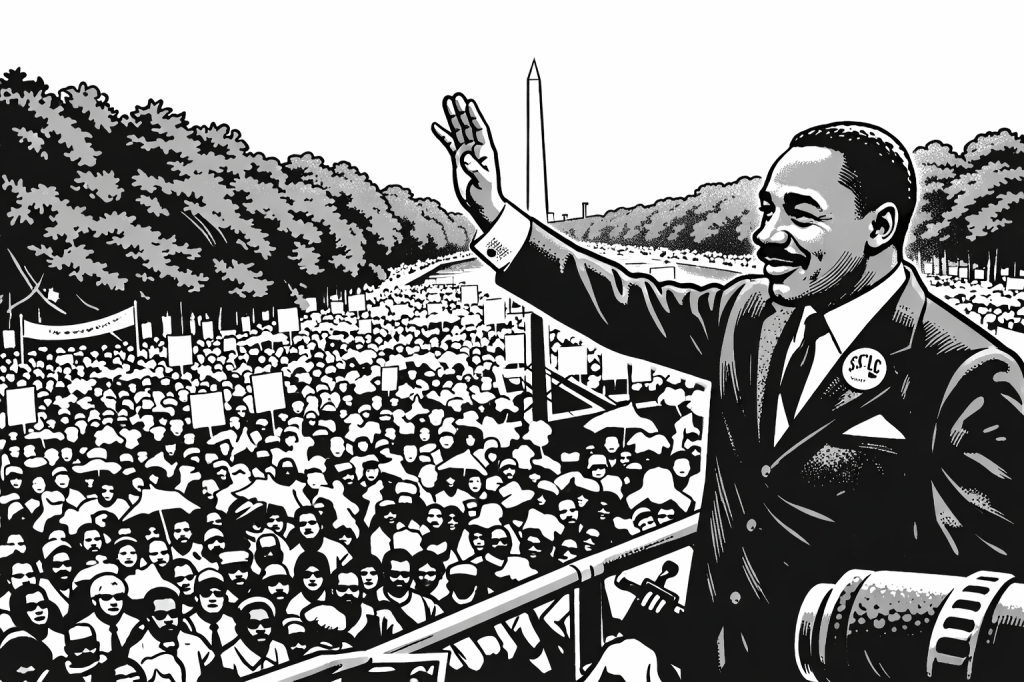
“Injustice anywhere is a threat to justice everywhere.” Martin Luther King Jr.
That sentence travelled widely yesterday. It deserves to. It is concise, morally demanding, and intellectually uncomfortable. But after the applause, a harder question remains:
What does that truth require of me, of us in Nigeria and across Africa?
Because while the quote is global, our capacity is not. No human being can fight injustice everywhere. At best, we can support those fighting within their own theatres of intervention. But even that support must not become a convenient substitute for the work we refuse to do at home.
There is an order to responsibility.
Jesus framed it as movement from the near to the far: Jerusalem, Judea, Samaria, and the ends of the earth (Acts 1:8). Your Jerusalem is your primary constituency, your country, your community, your people, your nearest moral obligation. This is not narrow-mindedness. It is discipline. It is the difference between concern and calling.
Martin Luther King Jr. did not build his legacy by chasing every injustice on earth. He confronted the specific injustice of his own society with such clarity that his message became universal. Even when he stood on the Nobel stage, he used the world’s microphone to speak about the wounds of his people. That is how moral authority is forged: by paying the price in your own land.
This is why I struggle with a growing kind of activism I see: loud about injustice “out there,” silent about injustice in Nigeria and Africa. Passionate about the failures of other nations, evasive about the rot at home. Quick to analyse external and developed democracies, slow to name local despotism. It is not sophistication. It is displacement. And in its worst form, it is hypocrisy.
Jesus gave another uncompromising warning: remove the log in your own eye before attempting to remove the speck in another’s (Matthew 7:3–5). The point is not that we should never speak about global injustice. The point is that we must not use global outrage as a mask for local cowardice.
The most credible moral voice is the one that has confronted the injustice it is closest to.
Africa does not suffer from a shortage of commentary. We suffer from a shortage of inward transformation. We do not lack critics of other systems; we lack builders of our own. We spend enormous emotional energy reacting to the politics of distant nations while normalising leadership failure, institutional collapse, and human suffering in our own countries.
And the cost is visible everywhere: an entire generation searching for safety and dignity elsewhere, as if relocation is the ultimate solution. But the uncomfortable truth is this: the nations that attract us were built, by people who took responsibility for their own home and fought for its stability. Those societies are defended fiercely because they were constructed sacrificially.
If Nigeria and Africa had lived up to its name and potential, would Nigerians and Africans be scattered across the world begging for space, dignity, and documentation?
Jesus once observed that even the foxes have holes and birds have nests, yet the Son of Man had nowhere to lay His head (Matthew 8:20). That line hits differently when applied to a continent of brilliance that still struggles to offer its own people a secure place to belong. Many Africans have become homeless and stateless at scale, not always because they lack land, but because they lack systems that work.
And here is the point I cannot escape: transformation is an inside job. No external force can build our nations for us. No foreign outrage can substitute for domestic courage. No social media analysis can replace the slow, disciplined work of building institutions, insisting on accountability, and forming a conscientious citizenry.
If we want to honour King’s quote honestly, the application for Africa is not performative global anger. It is local moral clarity.
Fight injustice where you have responsibility.
Speak where you have standing.
Build where you have roots.
Start in your Jerusalem.
Because injustice anywhere threatens justice everywhere, but the injustice we tolerate at home is the one that most effectively destroys our future.
And perhaps this is the sharpest lesson of the day:
The credibility to speak to the world is earned by the courage to confront your own world first.
Mandela, Gandhi, and King became global influences precisely because they fought injustice in their own countries first, with cost, clarity, and consistency. They did not outsource courage. They did not build reputations by condemning distant governments while tolerating oppression at home. Their universality was earned through local fidelity.
That is the standard we must recover.
It is morally wrong, and, in practical terms, destructive to hobnob with evil at home or bless it with our silence, while making a habit of criticising leaders in the Western hemisphere or other developed democracies. Silence at home is not neutrality; it is permission. And when we normalise injustice in our own societies, we lose the moral standing to speak as if we are guardians of justice elsewhere.
Yes, injustice anywhere threatens justice everywhere. But integrity requires order:
Start with your Jerusalem. Speak first to the injustice you can name without fear, confront without selective friendship, and resist without calculation. When you confront injustice at home, you do not become provincial, you become credible. And credibility is what gives your voice weight beyond your borders.
If we must critique, let it be consistent.
If we must speak, let it be courageous.
If we must fight, let it be first where we belong.
Otherwise, our global outrage reiterates itself as performance, and performance does not rescue children, reform systems, or restore nations.
Do have an INSPIRED week ahead with the family.
 Taiwo AKINLAMI