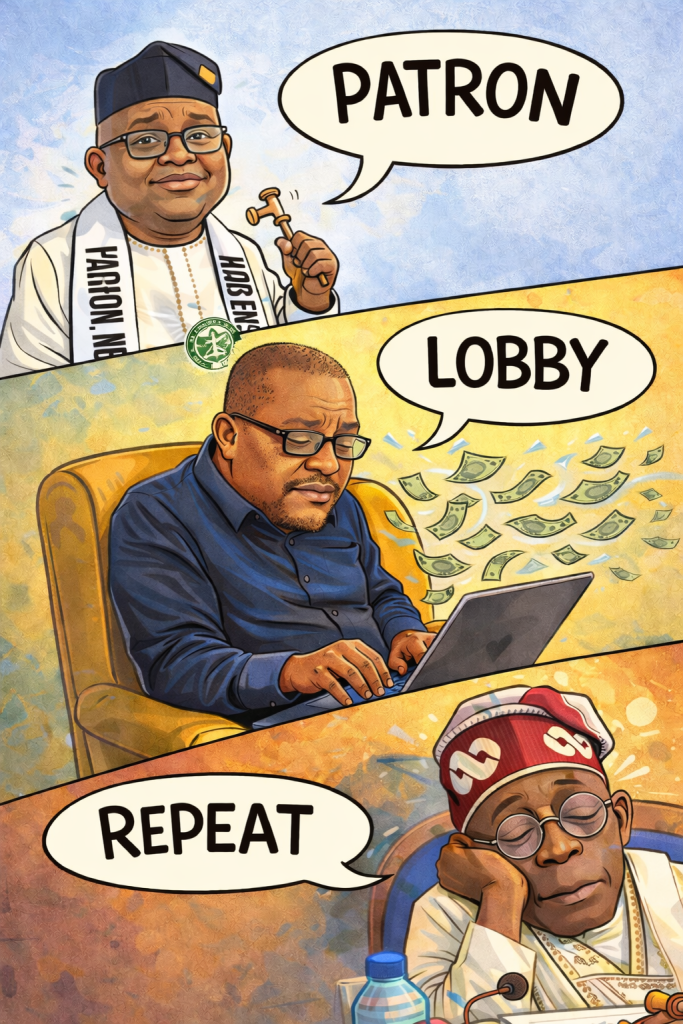
Nigeria is not short of paradoxes. What we suffer from is not merely misplaced priorities, because when a nation is already upside down, the word “misplaced” begins to sound like a compliment. You cannot misplace priorities in a country that stores its conscience in an unlabelled container marked “Miscellaneous.”
Three recent scenes capture the spirit of the republic. Not the constitution, the republic. The one we actually live in.
Paradox One: The Bar, the Bench, and the Grand Patron of Shame
The Nigerian Bar Association’s Garki (Abuja) Branch reportedly “honoured” Abdulrasheed Maina, widely reported as a convicted ex-official, by naming him “Grand Patron.” Then the national NBA leadership disowned the appointment and condemned it.
And honestly, I saw two things, neither of them strange.
First: I did not see the Abuja Branch doing anything unusual. It merely stopped pretending. In a profession that now flirts openly with power and money, the only scandal here is the branch’s honesty. Others commit the same romance in private; Abuja simply brought the relationship to the altar and said: “What are you all acting surprised for?”
Second: let us be serious, was the conviction the problem, or the bad timing?
Because I suspect that if the branch had appointed a politician who is allegedly corrupt but not yet convicted, the outrage would have been softer, more philosophical, more Nigerian:
“Let us not judge.”
“Let the court decide.”
“Innocent until proven guilty.”
“Due process.”
(And other sacred hymns we sing to protect the powerful from consequences.)
So perhaps the lesson is tactical, not moral: next time, choose a patron whose file is still “under investigation,” preferably one skilled in the Nigerian arts of procedural acupuncture, adjournments, technicalities, perpetual injunctions, and that greatest constitutional amendment of all: connections.
And yes, someone like a former Attorney-General, Malami might even qualify for consideration, not because he is clean (I am not asserting that), but because in Nigeria, eligibility is often measured by a simpler test: are you still in favour with those who control the machinery?
When you fall out with power, you become “controversial.” While you remain in power, you are “distinguished.”
That is why Nigeria is not a country; it is a courtroom where the verdict depends on who is funding the stationery.
Paradox Two: Lobbying Reality Instead of Changing It
Then came the report that Nigeria hired U.S. lobbyists under a contract that totals $9 million (reported as $4.5 million for six months, renewable for another $4.5 million), to persuade Washington of Nigeria’s efforts regarding violence and the “Christian genocide” narrative.
This is where Nigeria becomes a poet, because only a poet believes you can bribe perception while abandoning reality.
So we are told: pay millions so America will think something else.
Meanwhile, insecurity continues to chew through lives and communities, and the state continues to speak the language it speaks best: statements, committees, and condolences.
You see the paradox?
We are not investing $9 million in stopping the bleeding.
We are investing $9 million in explaining the bleeding.
The lobbyists are being asked to do the impossible Nigerian job: to negotiate with facts. To approach reality like it is a stubborn civil servant that can be “settled.”
And then, as if Nigeria’s satire department needed extra funding, a New York Times-linked controversy is reported in local Nigerian media as involving an Onitsha “screwdriver trader” whose claims allegedly influenced U.S. policy conversations about Nigeria.
So now we know: in the new national security architecture, the screwdriver is not just a tool, it is an intelligence asset.
Nigeria used to export crude oil; now we export confusion.
And the insult is not only the money, it is the logic: we will spend to manage the headline, not to change the story. We will polish the mirror, not wash the face.
Paradox Three: Repeat the Class, Not Because You Failed, But Because Failure Is the Curriculum
Finally, the 2027 drumbeat: reports that former lawmakers, under the umbrella of the National Forum of Former Legislators, endorsed President Bola Tinubu for 2027, with remarks reported from Chief of Staff Femi Gbajabiamila at/around that event.
Here I remembered the old Edo anecdote credited in Nigerian political storytelling: when people complained that Lucky Igbinedion was not doing well, his father reportedly replied, if a child fails, you let him repeat the class.
Perfect. A complete philosophy of governance in one sentence.
But the part we always forget is what repetition is supposed to mean:
Repetition is not a reward.
Repetition is the school’s way of saying: you did not learn this, go back.
Nigeria has improved the logic: we now make leaders repeat not to learn, but to perfect the failure.
And the nation is full of measurable pain that no endorsement can vote out of existence: poverty remains widespread by major international estimates, with the World Bank projecting that nearly half of Nigerians were living in poverty in 2024.
On education, different credible sources report different “out-of-school” counts depending on definitions and age ranges, UNICEF cites about 10.5 million children out of school, while UNESCO’s GEM materials cite 20 million for Nigeria.
So yes, let him “repeat the class.”
But Nigeria is not a classroom. Nigeria is a hospital. And we are re-electing the surgeon because the cemetery is full and we want consistency.
The Nigerian Genius: Naming the Rot and Calling It Order
So these are my three paradoxes of ignominy:
✅A Bar that accidentally tells the truth, and gets punished for failing to pretend properly.
✅A state that hires lobbyists to argue with global perception while leaving the underlying insecurity to continue auditioning for tomorrow’s headlines.
✅A political culture that treats national decline as a qualification for continuity, because in Nigeria, repetition is not remediation; it is tradition.
Nigeria is the only place where disgrace is not the end of the road, it is a signpost: “Next Level.”
And that is why “misplaced priorities” is too gentle.
Our priorities are not misplaced. They are perfectly placed, on the neck of the citizen, so the nation can sit comfortably on our air and call it governance.
Do have an INSPIRED week ahead with the family.
 Taiwo AKINLAMI