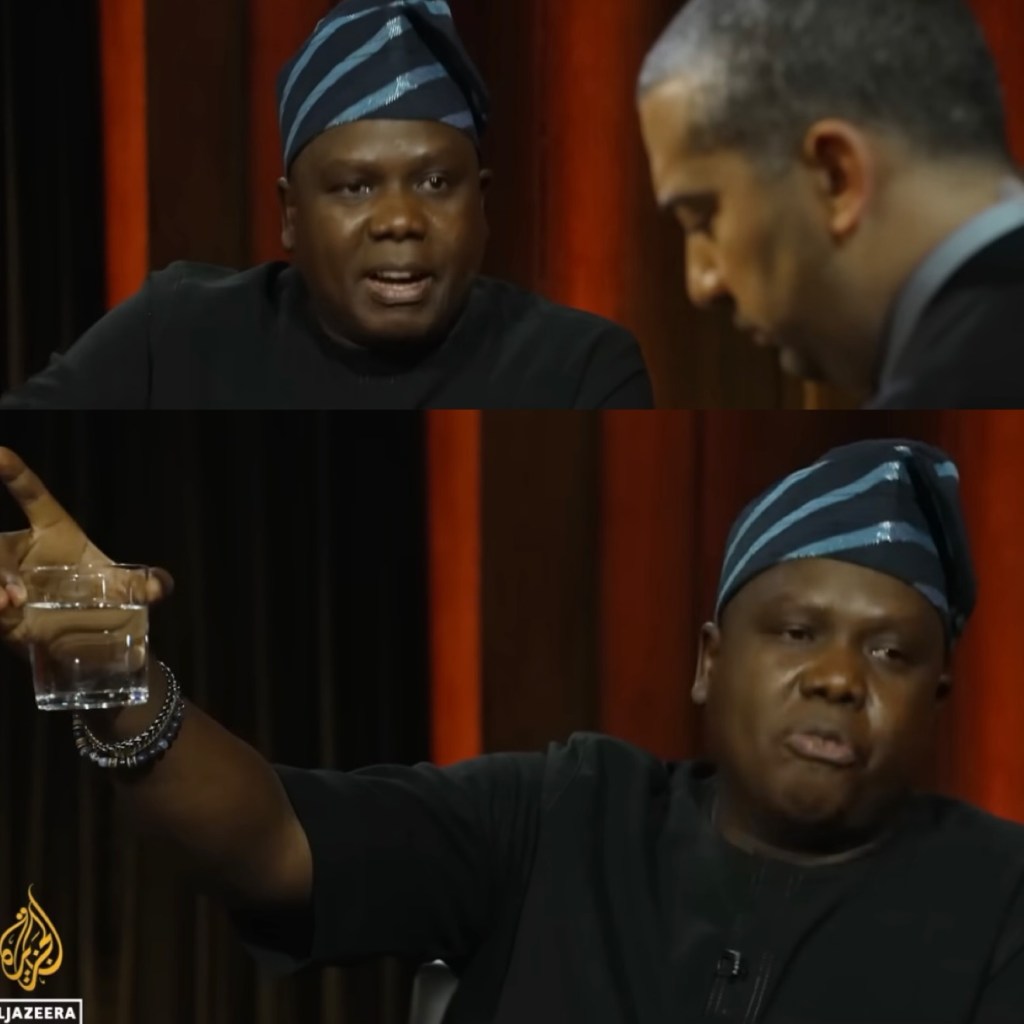
Some interviews are difficult. Others are revealing. A rare few become something more serious: a public reckoning.
Daniel Bwala’s appearance on Head to Head with Mehdi Hasan belongs in that last category.
What made the exchange so damaging was not merely that the spokesman for President Bola Ahmed Tinubu faced sharp questioning on insecurity, corruption, poverty, democratic decline, and the hardship confronting ordinary Nigerians. Public officials are expected to face scrutiny. What made this interview memorable was something more devastating: again and again, Bwala was confronted not simply by an interviewer, but by his own record. His previous statements were quoted back to him, and each time they returned, his present defence weakened.
That was the true drama of the evening.
This was not merely a difficult media outing for a presidential spokesman. It was a collision between a man and his own words. Statements he had previously made about Bola Tinubu, corruption, abuse of power, vote-buying, militia allegations, and democratic failure came back to meet him in public. And in that moment, the interview ceased to be a routine political defence. It became something far more severe: a reckoning with consistency, credibility, and truth.
A spokesman can survive a hostile interviewer. He can survive a foreign platform, an aggressive tone, even a bad news cycle. What is far harder to survive is documented contradiction placed before a global audience in real time. Once a man’s own words begin to testify against him, the familiar protections of partisanship start to collapse. It is one thing to dismiss critics. It is another thing entirely to dismiss yourself.
That was Bwala’s burden throughout the interview. He was not only defending the Tinubu administration against its opponents. He was defending his present self against his former self. And that is a much harder task.
The problem was not simply that he had changed his mind. People change their minds. Politics is full of reversals, re-evaluations, and realignments. A man may oppose a leader in one season and support him in another. That, by itself, is not discrediting. What is discrediting is the refusal to account honestly for the change. When a public figure has once made grave allegations against a man, and later goes on to serve that same man, the burden of explanation becomes moral as much as political. The public is entitled to ask: What changed? Which earlier claims do you now reject? Which do you still stand by? What facts emerged to justify the reversal?
Without such clarity, a change of position does not look like growth. It looks like convenience.
That was the impression left by this interview.
On issue after issue, Bwala seemed less interested in providing a forthright explanation than in escaping the weight of the record. There were denials where explanation was needed. There were evasions where candour was required. There were appeals to “context” that often seemed less like illumination than retreat. At critical moments, his defence appeared to rely not on persuasive truthfulness, but on deflection, selective doubt, and the hope that sheer performance might outrun memory.
But memory did not yield.
That is what made the encounter so powerful. Bwala was not primarily undone by Mehdi Hasan’s aggression. He was undone by the return of his own speech. His past words entered the room and would not leave. They sat beside him, contradicted him, and stripped his defence of force. In that sense, the most punishing witness in the interview was not the host. It was Daniel Bwala’s own public record.
The wider Nigerian context made the effect even sharper. This is not a country in which rhetoric can easily substitute for results. The burdens on ordinary life are too heavy. Insecurity is not a debating point to those who live with fear. Poverty is not an abstract policy category to those who cannot afford food, transport, school fees, or basic stability. Corruption is not a theoretical concern to those who watch public life consume trust, dignity, and hope. The more painful the national condition becomes, the less patience there is for official language that appears detached from lived reality.
That is why Bwala’s contradictions mattered. They were not merely personal embarrassments. They came to symbolize something larger about the Nigerian political class: its ease with reinvention, its loose relationship with consistency, and its willingness to treat yesterday’s moral outrage as today’s tactical inconvenience.
That may be the most unsettling lesson of the interview. It suggested not simply that one government spokesman had a bad night. It revealed a deeper crisis in political speech itself. Words once used to warn the public can later be shrugged off. Serious allegations can become disposable. Conviction can be recast as strategy. And when this happens without any sincere accounting, public language begins to lose its seriousness.
That is dangerous for any democracy. A democratic society can survive disagreement, opposition, hard interviews, and partisan struggle. What it struggles to survive is the hollowing out of public speech: the normalization of saying whatever the moment demands, and the assumption that citizens should accept each reinvention as though memory does not exist.
Yet memory did exist here. The record existed. And that was what made this interview unforgettable.
In the end, this was not simply about one spokesman’s discomfort on an international platform. It was about the enduring power of one’s own words. In politics, many things can be revised, reframed, denied, or rebranded. But words, once spoken, have a way of waiting. They remain. And when they return at the right moment, they can undo the performance built to outrun them.
That is what happened here.
Bwala came to defend a government. Instead, he found himself confronted by his own history. And once that happened, the rest was no longer a confident defence. It was a slow and public surrender of credibility.
Though he has been made, time and again, to swallow his own words, to eat pounded yam with his own vomit and then sleep in it , particularly in his encounter with former Mayor Mark Arnold, Mehdi Hasan’s life assignment will not be complete until he sits down with the Babaloja-General of Nigeria, Reno Omokri. Logistics should hardly be a problem now that he lives in Mexico, sustained by the fruit of his hard labor.
Have an inspired weekend with your family.
Shalom!
 Taiwo AKINLAMI