I know the power of the press.
Not from theory alone. Not merely from books or classrooms. I know it from life.
I encountered that power very early through the activism of my late uncle, Chief Gani Fawehinmi. As a young boy, I read newspaper reports of his battles to my maternal grandmother, who followed his public interventions closely, especially his relentless pursuit of justice over the killing of Dele Giwa, the founding editor of Newswatch. Those moments were my first lessons in the moral force of the media: how the printed word could pursue power, disturb impunity, and keep memory alive when the state wanted silence.
That early exposure changed me. Inspired by what I was reading, and by the example before me, I wrote my first article at the age of 18. It was published in The Punch on June 10, 1988. That same year, I began living with Chief Gani in Lagos, and what I witnessed there only deepened my conviction.
I saw, up close, how the media stood with him in his crusade against injustice, military repression, and unlawful arrests. In those days, there was no email. We distributed press statements by hand. I went from newspaper house to newspaper house, from television station to television station, across Lagos and Ibadan, carrying statements physically and watching how journalism worked in real time. I saw the interaction between my uncle and media professionals. I saw how ideas became headlines, how headlines shaped public conscience, and how public conscience, in turn, restrained tyranny.
That is why I say, without hesitation, that any cause without the backing of the press is like winking in the dark.
Today, the terrain has changed. The rise of the new media and the Fourth Industrial Revolution has transformed the very meaning of “the press.” The gatekeepers are no longer the same. The speed is unprecedented. The reach is wider. The power is even greater. But with that greater power comes greater vulnerability, greater manipulation, and greater danger.
Yes, regulation is necessary. No serious society can function without laws against libel, slander, cyber abuse, data violations, and related misconduct. Rights require boundaries. Freedom is not lawlessness.
But there is a vital distinction between laws that regulate responsibly and laws, actions, or pressures designed to suppress the press.
Nigeria knows that distinction well.
We remember Decree No. 4 of 1984, the notorious Public Officers (Protection Against False Accusation) Decree, which weaponised state power against journalism. That decree was not about truth. It was about intimidation. It was not about responsible reporting. It was about silencing scrutiny. It was one of the clearest symbols of a military mindset that believed power must never be embarrassed, questioned, or exposed.
That is why we must never take lightly the cry of a media practitioner who says: my life is under threat.
We must not treat such an alarm as routine. We must not dismiss it as drama. We must not shrug and move on.
And there are at least two reasons.
First, because of what the press represents in a country like Nigeria, where impunity often passes for governance and executive recklessness too often becomes the operating philosophy of state officials and agencies. In such an environment, journalists are not merely reporters. They are witnesses. They are record-keepers. They are among the last remaining obstacles to total arbitrariness. To threaten them is not merely to threaten an individual. It is to threaten public accountability.
Second, because we know how power operates in this country. We know how the law can be twisted by the powerful, how institutions can be bent, and how those entrusted with enforcement and interpretation can be pressured, influenced, or compromised. We know that in Nigeria, the danger is not only lawlessness. It is the selective use of law in the service of lawlessness.
That is why recent history matters.
Dele Giwa’s murder in 1986 remains one of the darkest stains on Nigeria’s social conscience. Chief Gani Fawehinmi, of blessed memory, accused the Ibrahim Babangida regime of responsibility for that killing. To this day, it remains unresolved. But Dele Giwa was not the end of the story. He was only its most emblematic symbol.
According to The ICIR’s summary of the UNESCO Observatory, at least nine journalists were killed in Nigeria between 2006 and 2019, and their cases remained unresolved at the time of that report. Godwin Agbroko was shot dead in 2006. Paul Abayomi Ogundeji was killed in 2008. Bayo Ohu was murdered in 2009. Zakariya Isa was killed in 2011. Nansok Sallah and Enenche Akogwu died in 2012. Ikechukwu Udendu was killed in 2013. Famous Giobaro and Ikechukwu Onubogu were killed in 2017.
These are not statistics. They are warnings.
They tell us that journalism in Nigeria is still a dangerous vocation. They tell us that the line between intimidation and elimination can be dangerously thin. They tell us that when a journalist raises the alarm, the country must pay attention.
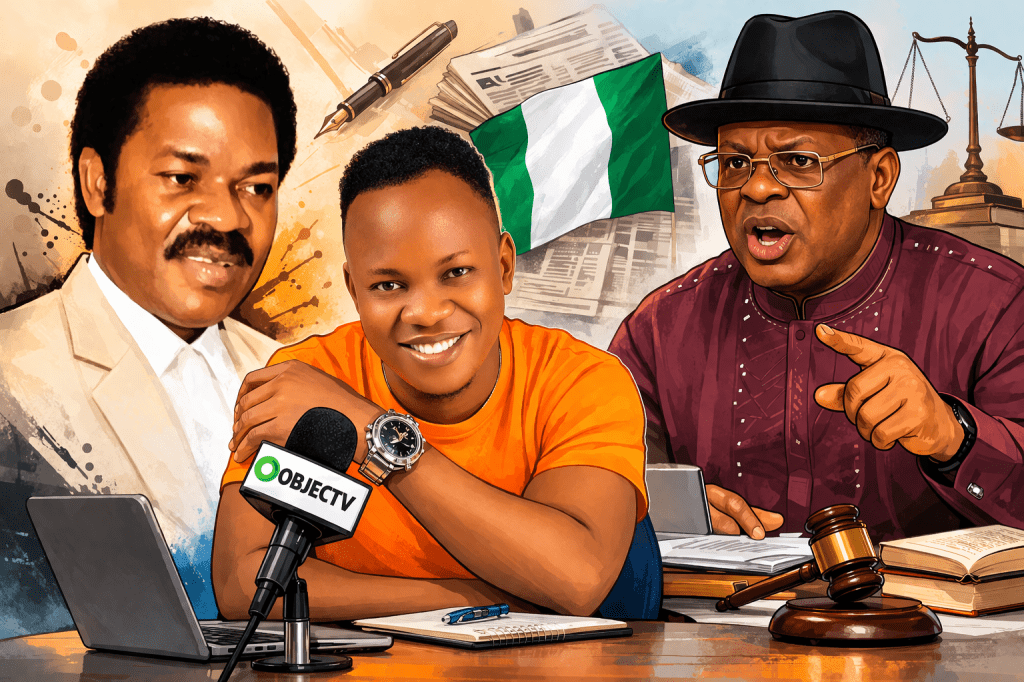
It is in this context that any public claim by a journalist or media professional that his life is under threat must be taken seriously, including the recent alarm reportedly raised by Segun O’Law of Objectv Media, particularly where such threats are alleged to have come from a public official like David Umahi. This is not least because he has, in recent times, been repeatedly caught in the swirl of public controversies, allegations, and what many observers consider suspicious apologies and recantations by accusers. Different individuals have alleged that he has used the power of his office, first as governor and now as minister, to trample on their rights. Whether or not such allegations are eventually established, they are too weighty to be dismissed with a wave of the hand.
That is exactly why claims of threats against a media person must provoke scrutiny, not scorn; seriousness, not mockery.
Just yesterday, I wrote about the so-called apologies by TracyNither Ohiri and Chief Obinna Udeh Nkama and reflected on what such reversals do to our national psyche in a country where the battle between the powerful and the powerless is never fought on equal terms. Then this new development broke: yet another allegation, this time of threats and of a demand for apology. Coming against the backdrop of those recent apologies, it inevitably raises troubling questions.
The Yoruba have a saying: Àjẹ́ ké l’ánà, ọmọ kú l’ónìí; ta ni kò mọ̀ pé àjẹ́ àná ló pa ọmọ jẹ?
The witches announced a feast yesterday; the child dies today; who does not know that it was yesterday’s witches that killed the child?
That proverb captures the moral burden of this moment. Are the recent apologies we have witnessed entirely spontaneous, or are they, like a masquerade dancing in the marketplace while the drummers remain hidden in the bush, performances whose real orchestrators stay out of sight? Are we looking at genuine recantations, or at the handiwork of unseen ventriloquists? These are not frivolous questions. In a country shaped by fear, power, inducement, and institutional weakness, they are necessary questions.
The press is not perfect. Journalists are not infallible. Media institutions are not above criticism or correction. But a nation that does not protect those who ask hard questions is preparing itself for darkness. And a government that is irritated by scrutiny is already telling you more about itself than any editorial ever could.
Nigeria must decide what it wants.
A frightened press or a free one.
A silenced witness or a speaking conscience.
A republic of accountability or a republic of intimidation.
For me, the answer is clear.
When a journalist cries out, Nigeria must listen.
Do have an INSPIRED rest of the day with the family.
 Taiwo AKINLAMI