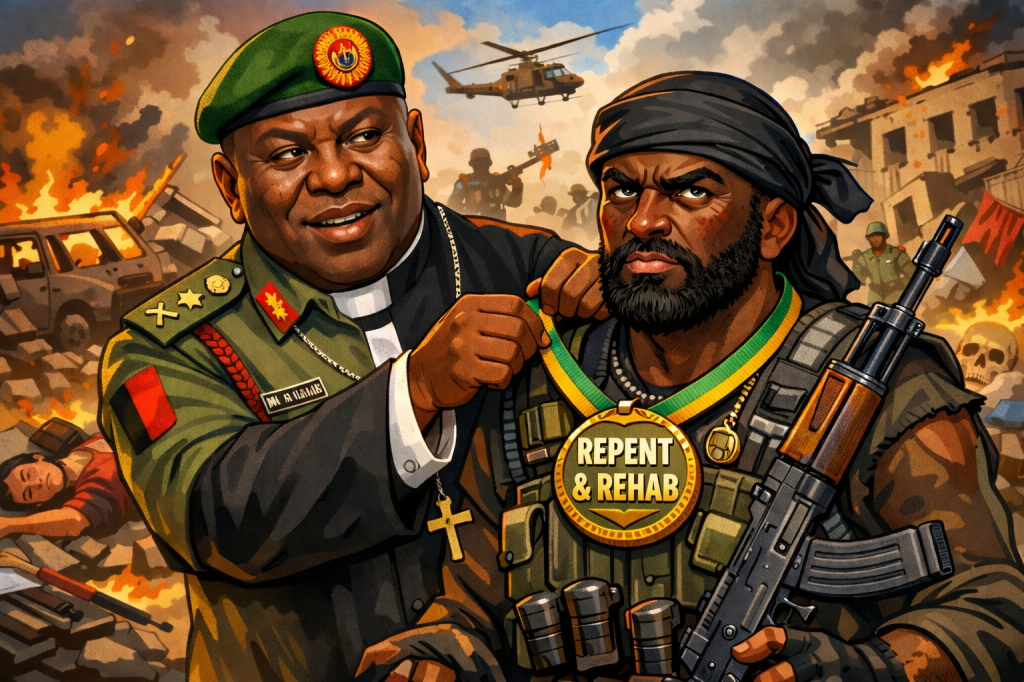
To compare terrorists to the prodigal son is not merely bad theology; it is an injury to both justice and mercy. The prodigal son was wayward, but he was not violent. He was wasteful, but he was not a public enemy. To force his story into the service of terrorist rehabilitation is to distort Scripture and expose a troubling confusion in the mind of the Nigerian state.
At a military lecture in Abuja, Chief of Defence Staff, General Olufemi Oluyede, reportedly argued that although many believe terrorists should simply be killed for the lives they have taken, the Nigerian state must still leave open a path for surrender, repentance, and rehabilitation. Invoking the biblical prodigal son, he suggested that no one returns where no door is left open. In essence, his case was that rehabilitation should remain part of Nigeria’s counter-insurgency response.
That statement reveals something deeply unsettling about the mind of the Nigerian state and its understanding of its constitutional duty. The Constitution declares that the security and welfare of the people shall be the primary purpose of government. Yet that duty has been repeatedly assaulted and gravely weakened by persistent terrorist attacks that continue to claim lives, destroy property, displace communities, and destabilise large portions of the country. The 2026 Global Terrorism Index ranks Nigeria as the fourth most impacted country by terrorism, behind Pakistan, Burkina Faso, and Niger. That ranking is not a mere statistic. It is an indictment. It tells us that Nigeria is now firmly counted among the world’s most terror-stricken and destabilised states.
First, the comparison between terrorists and the prodigal son is, on its face, either a profound theological error or a deliberate abuse of theology. The prodigal son committed no violent crime. He did not terrorise his community. He did not shed blood. He did not become a public enemy. He asked his father for his share of the inheritance, and his father willingly released it to him. He squandered his substance, yes, but his sin was wastefulness and moral failure, not mass murder, banditry, kidnapping, or insurgency. To place that parable beside the career of a terrorist is not interpretation. It is distortion.
Second, the state appears to be sermonising where it ought to be governing. It is one thing for religion to speak of repentance. It is quite another for the state to treat repentance as though it were a substitute for justice. The business of government is not to preach a theology of return while citizens are being slaughtered. Its duty is to secure life, enforce the law, prosecute crime, and defend the peace. Instead of presenting a compelling and effective programme for protecting the lives and property of Nigerians, the state is speaking in the language of rehabilitation and repentance. But what becomes of the lives being wasted daily while the state waits for terrorists to have a change of heart? And if they never repent, are citizens then doomed to remain at the mercy of their violence?
Yes, a terrorist may repent. But that is a matter between the individual and God. Even God, in His sovereignty, does not force repentance on anyone, nor does He surrender the peace of society to the uncertain hope that a wrongdoer may one day repent. The business of the state is different. The duty of the state is to bring offenders to justice through the criminal justice system, or to neutralise them lawfully in the field of battle where they violently resist arrest and engage the armed forces.
These are not harmless wanderers in moral confusion. They are deadly actors who, by public reports, have killed civilians, security personnel, and senior military officers in the course of violent conflict. So the real question is this: under what circumstances are terrorists killed? They are typically killed when, in the course of military operations, they engage the Nigerian Armed Forces in battle. Is the Chief of Defence Staff suggesting that soldiers under attack should fold their arms, suspend force, and begin to preach repentance? If the Nigerian state insists that terrorists are Nigerians whose lives must be preserved for rehabilitation, are the law-abiding Nigerians being killed, and the soldiers dying in defence of the country, somehow less Nigerian?
Perhaps it will be argued that the Chief of Defence Staff was referring only to those who surrender or are arrested. But surrender does not erase crime. Arrest does not cancel guilt. A surrendered or arrested terrorist remains answerable to the law. Yes, every accused person is presumed innocent until proven guilty. But the presumption of innocence is not an excuse for the state to abdicate its duty of diligent investigation and prosecution. On the contrary, it is precisely through due process that the state vindicates justice, preserves public confidence, and strengthens national cohesion.
As far as I am concerned, the statement credited to the Chief of Defence Staff was careless, insensitive, and deeply revealing. It was careless because it trivialised the moral gravity of terrorism by forcing it into a parable that does not fit. It was insensitive because it came from a state functionary speaking in a country where terrorism remains a daily and devastating reality. And it was revealing because it is broadly consistent with the character of a state that has too often appeared uncertain, indulgent, or confused in matters touching the security and welfare of its people.
Why do I say this reflects the mind of the Nigerian state? First, because it aligns with the state’s wider pattern of handling insecurity in a manner that often leaves citizens feeling exposed, abandoned, and unheard. Second, as of now, there is no public indication before me that the statement has been withdrawn, corrected, or openly rebuked by superior authority. Silence, in such circumstances, can sound like consent.
In the end, this is not simply about one reckless analogy. It is about a state that appears to have lost clarity about who it exists to protect. When terrorists are recast as prodigal sons while citizens are buried in silence, something has gone morally and politically wrong. The Nigerian state cannot continue to preach mercy to murderers while failing in justice to the murdered. Until it remembers that its first calling is not to sermonise to terrorists but to secure the lives, dignity, and peace of law-abiding Nigerians, its theology will remain strange, its justice suspect, and its legitimacy wounded.
 Taiwo AKINLAMI