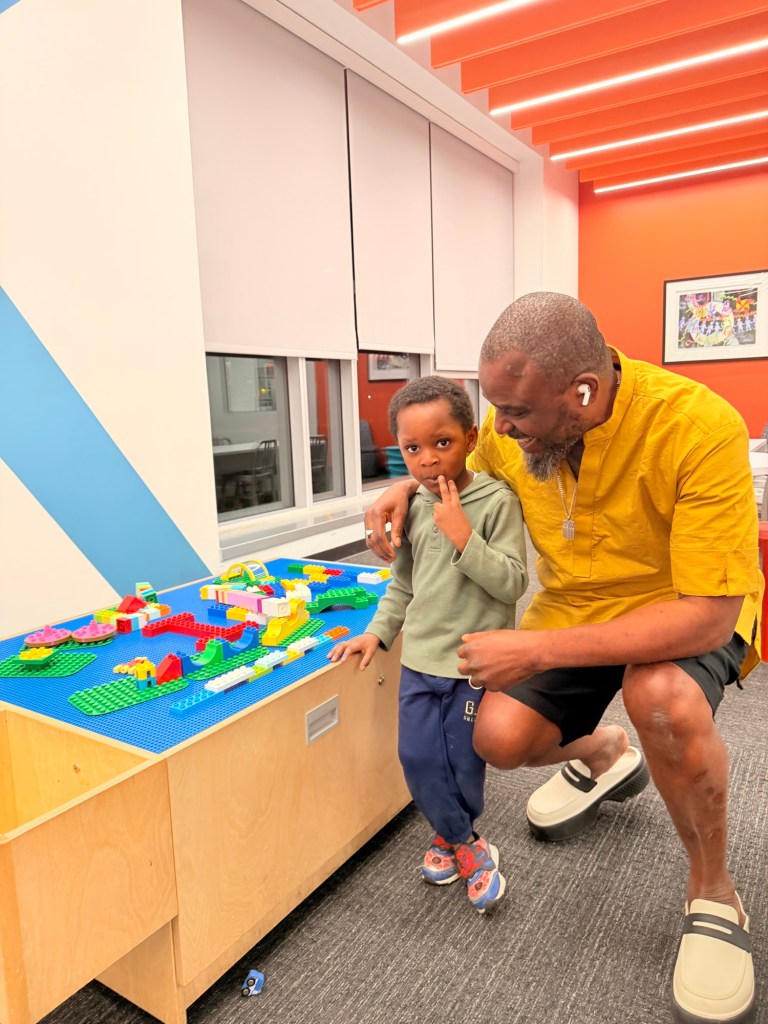
Tieri is four years old, and his words often leave me in awe.
There are moments when he says something so thoughtful, so perceptive, and so unexpectedly profound that I pause and ask myself, Did he really say that? Yet he did. And not just once, but often enough to remind me that childhood is never as empty as adults sometimes assume. There is wisdom in children that demands attention, if only we will listen closely enough.
Watching him brings Scripture alive in a fresh way. It reminds me that a child can indeed grow in wisdom and stature, and in favour with God and with man. It reminds me too that out of the mouths of babes, strength can still be ordained. Children are not merely learning; they are often, in their own way, teaching. In their innocence, directness, and honesty, they frequently expose truths that adults have either forgotten or learned to ignore.
Tieri is full of questions. He has opinions about many things. He pushes back. He is not the kind of child who can simply be silenced or hurried along without explanation. He wants to know. He wants to understand. He wants clarity. Except in moments where urgency, safety, or danger require immediate action, we try to answer his questions rather than dismiss them. We try to respect his curiosity rather than suppress it.
That matters deeply to me, because curiosity is not a defect in a child. It is often a sign of life, awareness, intelligence, and emerging conviction. One of the great responsibilities of parenting is discerning what in a child must be guided rather than crushed.
I remember hearing Mike Murdock share a story many years ago about his childhood. He spoke of being a talkative child whom others wanted silenced, until his mother said, in essence, that they must accept that the child was built to talk and simply pray that God would put the right words in his mouth in the right season. I may not be quoting it verbatim, but I have never forgotten the substance of that thought.
That is the same prayer I find myself praying for our son.
Because with Tieri, there are no dull moments. He always has something to say. He comments, questions, observes, and interprets life in ways that leave us smiling, thinking, and sometimes astonished. I have started taking note of some of the things he says.
He says, “I will try my best. Everybody is big enough to do something.”
After using the restroom, if I ask whether he washed his hands, he may ask me in return, “Did you wash your hand, Daddy? Because I did not hear you wash your hand.” In that moment, a four-year-old is not merely repeating a rule; he is holding his father accountable to the same standard.
He says, “Teamwork makes the dream work.”
One day, as I was about to wear indoor shoes outside, he corrected me immediately: “Those shoes are not meant for going outside.”
He says, “I want to be Pastor Taiwo,” perhaps because he sees me speak often and has concluded that anyone who stands to speak must be a pastor.
On another occasion, I was wondering aloud where I should post something, and he responded immediately, “LinkedIn,” because he has heard the language of my work often enough for it to enter his own frame of reference.
He says, “Good people don’t speak bad words. Only good words come out of their mouths.”
He says, “Jesus died for our sins.”
One day, trying to explain sin, he said, “Sin means when we displease God,” and then added, “like stealing money.”
Recently, another moment caught my attention. I was speaking on the phone with a colleague in the office about one of our upcoming programmes. In the course of the conversation, I mentioned only part of the programme’s name: “The TeacherFIRE®…” Before I could finish, Tieri completed it accurately: “You mean the The TeacherFIRE®…” Revolution.” That is the full name of the programme. I had not sat him down to teach him that phrase. He had simply heard it, registered it, and retained it.
On another occasion, he said, “Every part of my body is private to me.” Again, I had not formally taught him that exact sentence. We do have a training program and a song around that message because of another programme we have coming up, and somehow he had absorbed it, processed it, and made it his own.
That is what is so striking about children: they are always learning, even when we do not realise they are being taught. They are always listening, even when we think they are merely present. And they are always becoming, often through patterns of exposure that adults underestimate.
And then one day he said something particularly striking: “When I do the things I love to do, I’m a genius.”
What a statement.
There is so much to learn from a child like this.
As I watch him, I am not only learning about him. I am also being forced to revisit my own story.
I talked a great deal as a child too. For that, I was labelled a noisemaker and, later, a disturber. I was beaten in class for talking. I was beaten during assembly for being disruptive. Yet many times, what we were punished for was simply relating with our classmates when the teacher was not present. We did not speak when teachers were in class; fear took care of that. But the moment they stepped out, we connected with one another, and for that natural expression we were punished.
That experience affected me deeply. It did more than correct behaviour; it wounded expression. I was built to speak, yet I was repeatedly made to feel that my speech was a problem. I was wired for words, yet my words were treated as an offence. When that happens repeatedly to a child, the damage can go far beyond the immediate moment. It can confuse identity. It can distort confidence. It can make a gift feel like a burden. It can turn natural expression into something shadowed by shame.
So when I look at my son now, outspoken and inquisitive, unwilling to accept “no” without understanding why, I do not merely see a personality trait. I see a responsibility.
I see the responsibility to preserve, not crush.
I also see the power of environment.
Our son is growing up in an environment where there is a great deal of speaking. I facilitate programmes almost every day. He sees me teach, speak, and engage people virtually. He sees his mother in meetings too. He hears our vocabulary. He watches our rhythms. He absorbs our world. On one occasion, when someone asked where his daddy was, he responded, “My daddy is in his study. He has a speaking engagement.” On another, he said, “My daddy is in his seminar.”
That is remarkable, but it is also instructive.
Children are watching.
Children are listening.
Children are absorbing.
Children are becoming.
And this becoming is not accidental. It is shaped, in large part, by what surrounds them. They rub off on us, and we rub off on them. This is why parenting cannot be careless. It must be deeply intentional.
Every child is unique. Every child carries a distinct wiring, a different rhythm, a particular sensitivity, and a unique strength. The task of parenting is not to force every child into the same mould. It is to notice, understand, nurture, and preserve what is distinctive in each child.
This preservation is critical, because the goal of parenting is not merely control. It is preservation.
We must preserve childhood so that it can mature properly into adulthood.
Only a preserved childhood can transition into a healthy, responsible, and functional adulthood. But when childhood is repeatedly interrupted, shamed, silenced, or truncated, what often enters adulthood is not wholeness, but injury; not strength, but distortion; not maturity, but unresolved fractures wearing adult clothes.
This is why parenting must be tender, observant, and discerning.
We are raising delicate human beings. Every child is delicate in some way. Every child has a gift that can either be nurtured or neglected. Every child has a uniqueness that can either be affirmed or suppressed.
Our task is to know that uniqueness.
Our task is to pay attention.
Our task is to give it expression.
Our task is to protect it.
Our task is to preserve childhood for the sake of a glorious adulthood.
That is one of the great lessons Tieri is teaching me.
He is teaching me that a child’s voice matters.
He is teaching me that curiosity is not stubbornness.
He is teaching me that questions are not threats.
He is teaching me that personality should be guided, not crushed.
He is teaching me that the things we dismiss in children may, in fact, be clues to their future.
And perhaps most powerfully, he is reminding me that what a child becomes tomorrow is often hidden in what they are expressing today.
Parents must pay attention.
Because what looks like “too much talking” may actually be the early signs of a voice meant to shape lives.
What looks like endless questions may be the stirrings of wisdom.
What looks like resistance may be the seed of conviction.
What looks like childish chatter may be the raw material of future influence.
Children are not interruptions to be managed.
They are lives to be studied, understood, and stewarded.
And if we do that well, we will not merely raise children who obey.
We will raise adults who are whole.
Do have an INSPIRED weekend with the family.
 Taiwo AKINLAMI