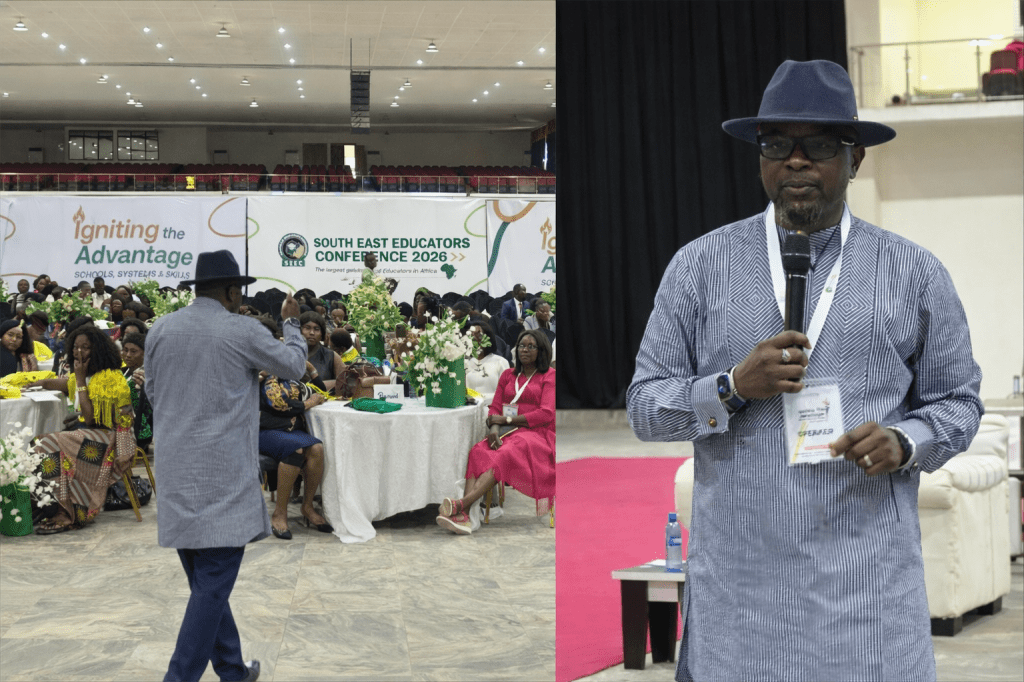
Last week, I could not write Homily from the Pew. I was on the road, moving from Enugu to Aba, from Aba to Owerri, from Owerri to Lagos, then to Anambra, and back to Lagos, in the work of ministry: preaching the Gospel, strengthening families, and advocating for a safer, more protective environment for our children.
I returned to Lagos on Friday exhausted, and I almost did not write this week either. But I could not let it pass. There is a burden on my heart, and the recent disorder, insecurity, and insensitivity surrounding the UTME, popularly known as JAMB, has brought that burden into even sharper focus.
Every year this examination is conducted, it reveals something deeply troubling: the heart of the Nigerian state toward its children.
It reveals lack of preparedness.
It reveals insecurity.
It reveals disorder.
It reveals indifference.
And it reveals a nation that continues to make the simplest things unbearably difficult for the very children whose progress should be a national priority.
These are children who are trying to move forward through education, not only for themselves, but for their families, their communities, this nation, this continent, and indeed the world. When great minds invent, create, discover, and build, it is not only their families that benefit. Humanity benefits. In the same way, when children are neglected, brutalized, and denied fair opportunity, the consequences do not end in their homes. Society pays for it.
When a child is damaged, the world eventually feels it.
That is why what many dismiss as “just an exam problem” is not a small matter. It is not administrative inconvenience. It is not a seasonal irritation. It is a moral indictment.
If a nation cannot educate its children properly, if it cannot guarantee their safety while they pursue education, and if it cannot guarantee fairness in the conduct of examinations, then that nation has a serious problem.
What is even more painful is that we keep refusing to address the real issue. We offer parents coping mechanisms. We advise children to be resilient. We preach patience to teachers and schools. But we tiptoe around the central truth: government must be held accountable.
In the 21st century, how can a country still fail, year after year, to conduct a basic transitional examination for children moving from secondary school to higher institutions without chaos, fear, delay, cancellation, or injustice?
According to reports, 14 children were kidnapped in Benue State in connection with this examination process. Two of them, we are told, were from the same family, born of the same father and mother. Because of that insecurity, they could not write the examination.
So let us ask the hard question: must the destiny of children be suspended because the state is incompetent? Must their future be put on hold because government cannot provide safe, accessible, and orderly conditions for them to sit an examination?
Who are the children who suffer most under this arrangement? They are not the children of the privileged. They are not the children of the upper crust. They are not the children of the highly connected. They are the children of ordinary people. They are the children of the poor. The children of those who labour quietly. The children of hewers of wood and drawers of water. The children whose parents cannot buy alternatives, private protections, special access, or elite pathways around public failure.
That is why I keep saying, for those who care to listen, that the idea of the Nigerian child has almost disappeared. What we have now are two categories of children. There are children whose parents, by personal sacrifice, can provide education, healthcare, shelter, security, and opportunity. Then there are children whose parents cannot carry all those burdens alone. Those children are practically stateless, because the state does next to nothing for them.
Look at what many of them go through simply to write an examination that is supposed to move them forward in life.
Last year, there were glitches. Examinations were disrupted. Some children suffered the consequences of institutional failure. This year again, we are seeing disorder and insensitivity.
Take, for example, what our precious children also endure in order to sit WAEC. One quickly sees that the recurring chaos surrounding JAMB is not a fluke. It is evidence of a wider culture of reckless impunity and contemptuous disregard by the Nigerian state for the collective destiny of our precious children.
During WAEC last year, examination materials arrived late in some places.
In communities without electricity, children reportedly wrote their examinations under conditions that should disgrace any serious nation.
Comparable foreseeable and avoidable failures attend the conduct of JAMB, as I have shown here.
Yet, after pushing our children through these hostile, anti-child, anti-learning conditions, we still turn around and judge their performance as though they had been examined fairly.
This is injustice layered upon injustice.
Let me say this clearly: there is no nation on earth where the responsibility of raising children rests on parents alone.
There are four institutions responsible for raising a child.
The first is the family. The family is foundational. It is where values are first formed, where character is first shaped, where discipline, dignity, empathy, and moral direction are first taught.
The second is the community. The community includes neighbours, schools, faith institutions, the media, civic groups, and the wider social environment. The role of the community is to reinforce the good values planted by the family and to build institutions that support children’s growth and flourishing.
The third is the state. The state must create a level playing field. It must establish just policy, provide social protection, secure public spaces, build infrastructure, and guarantee basic fairness. A state that cannot protect children, educate them properly, or administer examinations justly is failing in one of its most elementary duties.
The fourth is the international community, which sets broader standards and frameworks. But of these four, the family is not meant to stand alone. In fact, the state and the community are supposed to strengthen the family so that families can succeed in raising children well.
What do we have in Nigeria today? A complete mess.
And the tragedy is that when these matters arise, many people become afraid to locate responsibility where it truly belongs. Everybody is advised except government. Parents are advised. Teachers are advised. Children are advised. But government, the chief custodian of public systems, is treated with caution, as though naming its failure is somehow unfair.
No. We must put culpability where culpability belongs.
What our children are being subjected to is unacceptable. It is unconscionable. It is dangerous. It is anti-child. It is anti-education. It is anti-future.
And then there is the larger question: if government cannot competently run a national examination like JAMB, why do we keep insisting on it? If students must still sit additional screening or examinations conducted by individual universities and other tertiary institutions after passing UTME, then one must ask whether JAMB has outlived its usefulness in its present form.
If the machinery to administer it fairly, safely, and efficiently is absent, why should children continue to bear the cost of that failure? Why should they be dragged through anxiety, exposure, injustice, and trauma for a process that government itself has shown repeatedly it may not be able to manage well?
Why not allow institutions to handle their own admissions directly, if that will reduce harm, confusion, and systemic failure?
These are not abstract questions. These are urgent questions. These are justice questions. These are child-rights questions.
We must stop normalizing the suffering of children.
We must stop managing outrage with excuses.
We must stop treating institutional failure as though it were an unavoidable feature of national life.
Our children deserve safety.
Our children deserve dignity.
Our children deserve fairness.
Our children deserve systems that work.
And those in government must be held accountable until these minimum standards are met.
I write this today from a place of pain, concern, and deep sadness.
But I also write from conviction: this must stop.
Do have an INSPIRED week ahead with the families.

