VITAL OBITER®
I honestly do not know how anyone keeps up with the barrage of absurdities that continually confronts us as Nigerians.
Even if public commentary is how you earn your living, how do you cope?
Just when you think you are done for the week, something else happens. Something that makes silence difficult.
Perhaps what sustains those who continue to speak is love for country and the consciousness that we are not speaking only to today.
As my friend and brother Dele Farotimi would say, we are speaking into the womb of history.
And so, here we are again.
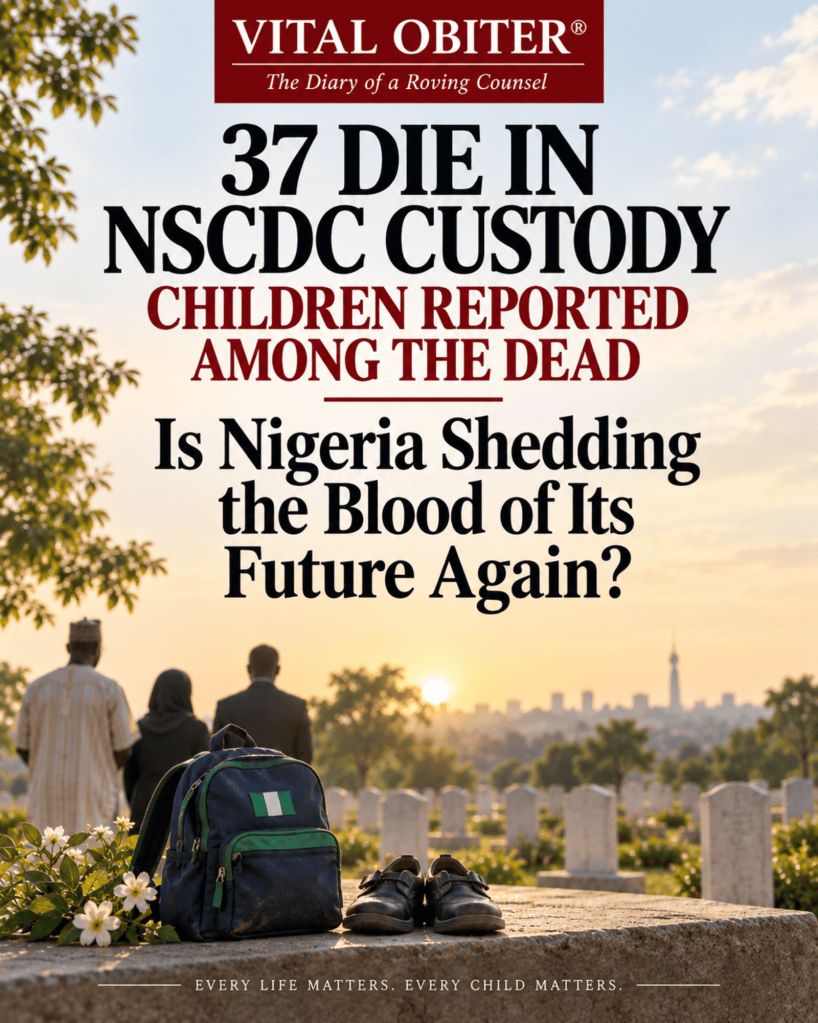
Thirty-seven people have died in the custody of the Nigeria Security and Civil Defence Corps in Minna, Niger State.
According to Reuters, Niger State Governor Umar Bago said many of the dead were aged between 14 and 18. Those below 18 were children.
How?
Not one. Not two.
Thirty-seven human beings.
They had been arrested during operations against suspected illegal mining.
Suspected.
They had not been convicted.
But even if they had been convicted, when did conviction extinguish humanity?
OUR COURTS ANSWERED THAT DECADES AGO
In Peter Nemi v. Attorney-General of Lagos State & Anor (1996) 6 NWLR (Pt. 452) 42, the Court of Appeal confronted the proposition that a condemned prisoner was effectively already dead and therefore without enforceable fundamental rights.
Uwaifo JCA demolished it with haunting illustrations. Could his limbs be systematically destroyed? Could his legs be set on fire under a pot to boil rice simply because he was supposedly as good as dead?
The point was unmistakable:
A condemned prisoner remains a human being.
Ten years earlier, in Aliu Bello & 13 Ors v. Attorney-General of Oyo State (1986) 5 NWLR (Pt. 45) 828, Nasiru Bello was executed while his appeal against his death sentence was still pending. The Supreme Court held the premature execution unlawful.
That was forty years ago.
How are we here in 2026 asking how 37 suspects entered government custody alive and came out dead?
AND THE CHILDREN?
This is where, after close to three decades as a Family Attorney and Family-Strengthening and Child-Safeguarding Innovator, with Child-Rights Advocacy central to my work, I have even more questions.
If children were among those arrested, who detained them, and under what child-safeguarding framework?
Were children detained with adults?
Where was social welfare?
Where was diversion?
Where was safeguarding?
Nigeria’s Child Rights Act 2003 treats detention of a child pending trial as a measure of last resort.
But there is a question before detention.
If children were found working in mining, what did the State encounter?
Only suspected offenders?
Or children possibly engaged in hazardous child labour?
For more than a decade, the International Labour Organization has emphasised social protection as a critical component of addressing child labour and the economic vulnerability that drives it.
So when the State encounters a child in dangerous mining, surely the question cannot end with:
“What offence has this child committed?”
What brought the child there?
Poverty? Exploitation? School exclusion? Family vulnerability?
Who employed the child?
Who profits from the child’s labour?
Where was social protection before law enforcement arrived?
And then we rescue—or arrest—a child from the danger of mining, only for that child to die in government custody?
Which nation sheds the blood of its future?
WHAT HAPPENED IN MINNA?
Here, we have accounts from people who survived that cell.
One survivor said 17 people were initially locked inside a small room before more detainees were added. He said they complained that the room was too small and intensely hot. He alleged that something with a strong smell was sprayed before the room was locked. People began falling. They pleaded for water but, according to him, were told the door would not be opened.
Another survivor said he survived because he was close to the entrance, where he could breathe better.
“We were screaming for help,” he said. Guards were warned that people were dying one after another, but, according to his account, they did not believe them.
These are survivor accounts, not yet final forensic findings.
But they are evidence that any credible investigation must confront.
Indeed, Governor Bago himself said suffocation arising from overcrowding was among the possible causes being investigated.
And this does not occur against a blank canvas.
In February 2026, Amnesty International documented severely overcrowded, poorly ventilated and unsanitary cells at the Police Anti-Kidnapping Unit at Tiger Base, Owerri, including serious health complications and deaths.
Different agency.
Different facility.
But the same unavoidable question:
What is the condition of human custody in Nigeria?
AND THEN WE BURIED THEM
Reuters reports that the 37 were buried in accordance with Islamic tradition.
I respect that.
But I must ask:
Where was this reverence for religious obligation while these human beings were alive?
This is not an argument against Islam or Islamic burial rites.
It is a question about selective reverence.
Surely, the religious injunction that commands dignity for the dead does not excuse us from doing right by the living.
We cannot become meticulous about religious requirements for laying 37 bodies in the ground while being casual about how 37 living human beings came to require burial in the first place.
And there is an evidential question.
Governor Bago said forensic examinations, medical examinations and autopsies were being conducted.
Were autopsies conducted before burial?
Were blood, tissue and toxicology samples preserved?
Are there post-mortem reports?
If not, how will the promised forensic investigation conclusively establish what killed them?
The Federal Government has ordered investigations, and the police say they have secured the scene to preserve evidence.
But an investigation is not an announcement.
Was the instruction to investigate backed by immediate preservation of the evidence necessary to investigate—or will it become another impressive instruction on paper, crippled in execution?
THIRTY-SEVEN HUMAN BEINGS
Someone will say:
“Things happen everywhere.”
Of course they do.
But things happen for reasons.
Institutions develop patterns.
Forty years ago, our Supreme Court had to tell the State that it could not execute Nasiru Bello while his appeal was pending.
Thirty years ago, our courts had to remind the State that even a condemned prisoner remains a human being.
Today, we are asking how 37 human beings, with children reportedly among them, died in government custody.
I write as an egalitarian.
I write as a lawyer.
And where children are concerned, I write as a child-rights advocate.
Every one of those 37 lives mattered.
But if children were among them:
What kind of society encounters a vulnerable child in dangerous labour and responds in a manner that ends with that child dead in custody?
Thirty-seven human beings entered government custody alive.
They did not come out alive.
HOW?
And if children were among them:
IS NIGERIA SHEDDING THE BLOOD OF ITS FUTURE AGAIN?
VITAL OBITER®
The Diary of Roving Counsel

