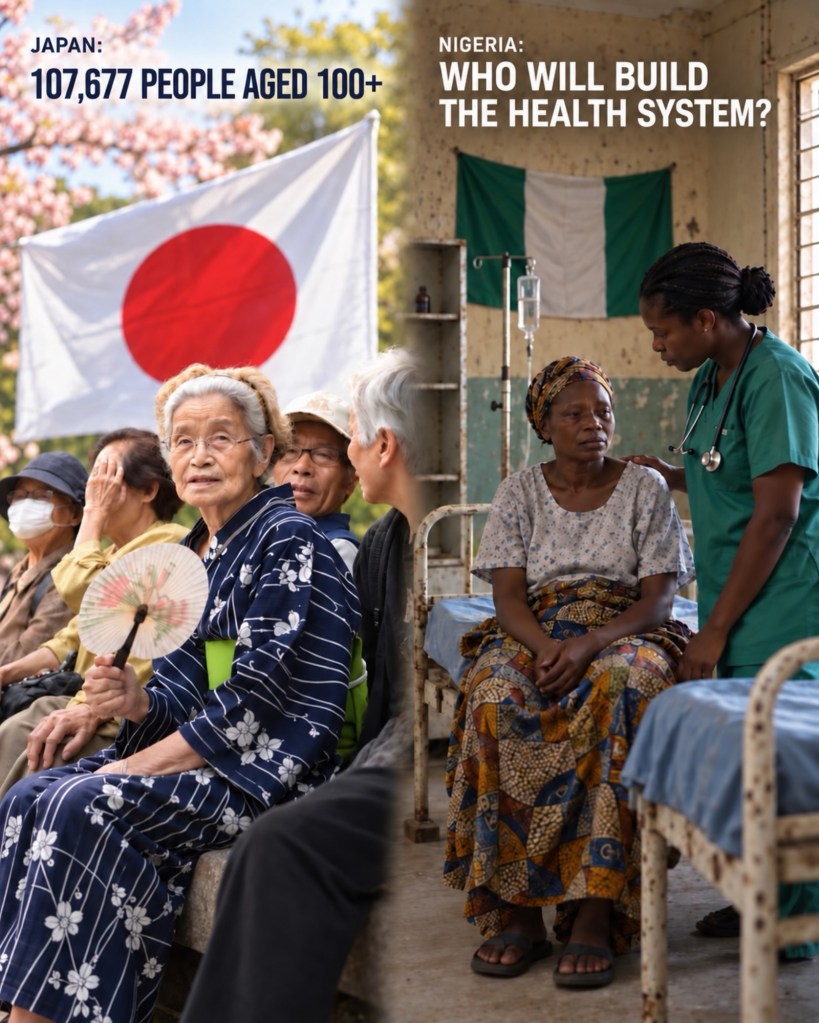
“With Long Life Will I Satisfy Him.”
But How Shall This Promise Become Reality in a Nation That Professes Faith in It While Its Health System Lies in Ruins?
HOMILYFROMTHEPEW
Japan has recorded 107,677 people aged 100 or older. When it began counting in 1963, there were only 153.
Japan’s population is approximately 122 million, about half Nigeria’s 242 million. Its rate is roughly 880 centenarians per million people. At that rate, Nigeria would have more than 210,000.
How many centenarians does Nigeria have?
I do not know because I cannot find an authoritative national figure. Japan knows because it deliberately counts.
Data is infrastructure for human dignity.
A country cannot plan for people it does not reliably count. Nigeria suffers from healthcare and data poverty.
We have not sufficiently befriended data.
But where our data are silent, life expectancy speaks. The latest World Bank figures place life expectancy at approximately 85 years in Japan and 55 years in Nigeria.
The 30-year difference is a generation.
The arithmetic does not rescue us.
It indicts us.
DID JAPAN DISCOVER PSALM 91?
“With long life will I satisfy him, and show him my salvation.” (Psalm 91:16)
Japan is not predominantly Christian or Bible-believing, yet has one of the world’s highest life expectancies.
This is not an argument against prayer.
It is an argument against prayer detached from responsibility.
GOD GIVES RAW MATERIALS; HUMAN BEINGS BUILD SYSTEMS
When God gave humanity dominion, He did not hand Adam a furnished apartment.
God gave us trees. Human beings imagined chairs, tables, doors, roofs, libraries and homes.
God gave us wool, cotton and animal skins. Human beings developed clothing.
God gave us iron ore. Human beings made farming implements, surgical instruments, bridges, railways, engines and motor vehicles.
God gave us sand. Human beings produced glass, lenses and computer chips.
God gave us crude oil. Human beings refined it into fuel and transformed its derivatives into thousands of products.
God gave us plants, herbs and chemical elements. Human beings studied them and developed medicines.
God gave us rivers, wind and sunlight. Human beings developed irrigation systems, dams, turbines and solar panels.
God gave us intelligence, imagination and curiosity. The Creator made humanity creative. Divine provision establishes rather than cancels human responsibility.
God supplied the garden, then placed Adam there “to dress it and to keep it.”
Whatever we refuse to work upon will not work for us.
WHAT, THEN, DOES FAITH MEAN?
After almost three decades as a person of faith, a journey I began on February 16, 1997, I reached this understanding not by private revelation alone, but through observation.
It is a verifiable pattern across Scripture and the history of believing people worldwide.
Anyone who cares to check can examine both and think it through: God speaks; people believe; because they believe, they act. They work the promise.
Faith, then, is belief translated into action. Belief accepts that God has spoken; faith begins to work what God has spoken by building a system for its implementation.
If I believe God will help me pass an examination, I study. Not everyone who studies passes, but refusing to study while claiming the promise is not faith.
If I believe God for healing, I seek treatment and take prescribed medication. Treatment does not compete with God; it expresses my faith that healing is possible.
Faith speaks, acts, plans, prepares and builds.
Docility is not faith. Refusing to act upon what we profess is faithlessness.
“Faith without works is dead.”
By that standard, are we becoming a non-believing nation, professing God’s promises while refusing to work them?
A believing nation is not the nation that mentions God most, but the nation that works what God has spoken.
If someone gives me a cheque, belief moves me to the bank. Prayer and thanksgiving will not cash it; action will.
God’s promises are divine policy statements, declarations of His will and values. An unimplemented policy remains words on paper.
When God promised Israel a land, the people still left Egypt, crossed the wilderness and Jordan, confronted opposition, occupied the land and cultivated it.
Caleb did not wait for the mountain. He said, “Give me this mountain,” and pursued it.
God’s promise authorised action.
Belief concerning health builds health systems; belief in education builds schools; belief in prosperity creates structures for productive work.
If human beings bear God’s image, faith builds institutions that protect their dignity.
Nothing that gives humanity comfort emerged from docility. Every house, medicine, vehicle, bridge and life-saving technology required thought, labour and organisation.
Joseph received divine insight, but Egypt survived because he administered a food-security system. Nehemiah prayed, then organised the people and materials that rebuilt Jerusalem’s wall.
Paul said, “I laboured more abundantly than they all: yet not I, but the grace of God which was with me.” Grace empowered labour; it did not replace it. Jesus said, “I must work the works of him that sent me, while it is day.”
“Except the Lord build the house” still has labourers building. It teaches dependence, not docility.
“I will heal their land” does not mean God will construct hospitals, reform institutions or govern for us.
Prayer gives direction; wisdom a plan; grace strength. Faith builds the system. Work transforms promise into reality.
In this respect, Japan’s institutions may be closer to God’s concern for life than a nation that loudly professes Him while tolerating avoidable death.
Nigeria’s problem may be that, in nation-building, we do not believe God enough to work what He has spoken.
WHILE WE WAIT FOR GOD
Japan established universal health coverage and invested in nutrition, vaccination, medical technology, hospitals and long-term care.
Values became policy; policy became institutions; institutions established practices; and those practices produced measurable outcomes.
We wait for God to fix Nigeria while God waits for Nigerians to work the country He gave them.
A health system we do not build will not descend from heaven.
Unprocured antivenom will not appear beside a dying patient.
A hospital without medicines, equipment and accountability is not functional because it has a chapel.
In January 2026, 26-year-old singer and architect Ifunanya Nwangene was bitten by a snake in Abuja. The first hospital she reached reportedly had no antivenom. When her landlord’s car failed, she booked a ride to the Federal Medical Centre.
She died in the nation’s capital after having to arrange her own transportation during a venomous-snake emergency.
Emergency care must be designed before the emergency occurs.
The painful irony is that people who may never quote our Scriptures build institutions that preserve life, while we who proclaim God tolerate avoidable deaths.
Privately, we pray, plan, educate our children and seek treatment. For Nigeria, however, we present prayer as a complete development strategy.
Prayer is not Nigeria’s problem.
Our problem is prayer without systems—prayer detached from planning, competence, investment, accountability and work.
“With long life will I satisfy him” is a promise, not an excuse for passivity.
Faith in that promise builds a society that protects life.
We must pray, then rise, think, count, plan, budget, build, equip, maintain and demand accountability.
God gave Adam the garden.
And God told Adam to work it.
That is the #HomilyfromthePew

