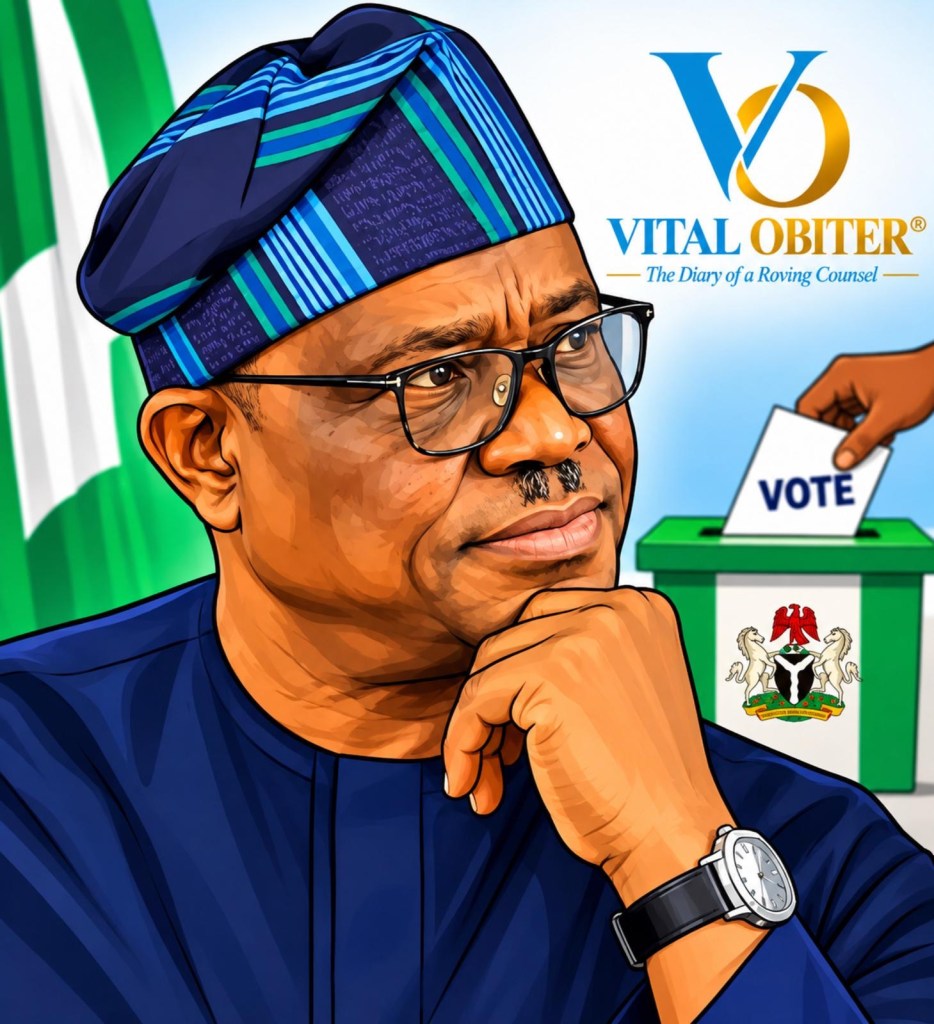
VITAL OBITER®
The Diary of a Roving Counsel
For some time, I have deliberately restrained myself from commenting directly on Nigerian politics.
Not because I have stopped caring.
I am an egalitarian to the core. I will remain one until my last breath. My commitment to a better Nigeria, a just society and human dignity is non-negotiable.
Nigeria is where my umbilical cord was buried. I am forever yoked to her.
But I am increasingly exasperated.
We talk. We analyse. We protest. We advocate. We condemn.
To what end?
I have begun questioning whether much of our political commentary, including what we call social activism, has become an elaborate exercise in futility.
Then came Nyesom Wike.
Nigeria’s Minister of the Federal Capital Territory publicly promised ₦10 million to each councillor who delivers his ward for President Bola Tinubu in 2027.
Sixty-two councillors. Potentially ₦620 million!
A serving minister. A lawyer. A public promise tied to electoral outcomes.
He has defended it as a reward for political mobilisation rather than vote-buying.
But what gives a public official the confidence to make such a declaration openly?
Where is the fear of consequences?
We have electoral laws. But what is the value of laws if their enforcement is uncertain, especially against the powerful?
And so I return to a conviction I have held for years: Nigeria needs its own political dictionary.
Not a dictionary of what words mean in political science.
A dictionary of what they have come to mean in our political experience.
ELECTION: What is presented as an exercise in choosing leaders, but which I increasingly regard as an arrangement for legitimising the forceful takeover of political power.
POLITICAL PARTY: Supposedly an organisation of shared principles and policies. But where are the distinguishing convictions? What separates one party from another beyond access to power?
CAMPAIGN: Supposedly a contest of ideas. How often does it become a marketplace of patronage, inducement and promises?
OPPOSITION: Supposedly an alternative government in waiting. But how meaningful is opposition when political loyalties can change overnight?
JUDICIARY: The institution to which aggrieved citizens are directed for justice. But what happens when confidence in its independence is profoundly shaken?
GOVERNMENT: An institution established for the security and welfare of the people. But whose interests does it actually serve?
DEMOCRACY: Government of the people, by the people, for the people.
But where are the people?
Poverty has been weaponised. Millions of children are outside school. Livelihoods are precarious. The political elite educate their children while countless other children struggle for basic education.
How do you exercise political power when survival itself has become your daily emergency?
We say power belongs to the people.
But what happens when the people are deprived of the means to exercise that power?
Consider the recent American midterm elections. I speak neither as a Democrat nor as a Republican. Amid widespread economic dissatisfaction, voters expressed their discontent through the ballot.
Now consider Nigeria.
In 2023, amid fuel scarcity, currency chaos and severe economic hardship, the ruling party retained power.
Since then, suffering has deepened considerably.
Yet, judging by our electoral history, I have no confidence that this suffering will translate into electoral consequences in 2027.
Mark my words: I do not expect the hardship Nigerians have endured to determine the outcome.
Don’t get me wrong. Nigerians may cast their ballots to express their dissatisfaction, but I have no confidence that our electoral mechanisms will faithfully reflect those votes. Our electoral history gives me little reason to trust the integrity and transparency of the process.
In America, public dissatisfaction can change who governs. In Nigeria, my concern is that the political class can retain power regardless of how deeply the people suffer.
Meanwhile, preparations for 2027 continue.
Television studios will fill with analysts.
Polls. Predictions. Permutations. Electoral arithmetic.
Who will win? Who will defect? Which coalition will prevail?
But who is asking the foundational questions?
What happened in 2023?
What happened to the technological failures, disputed results and documented shortcomings in electoral transparency?
What has fundamentally changed?
Why are we analysing the next election without first interrogating the integrity of the process?
I am 56. I grew up in Nigeria. I have watched this country for decades.
I refuse to pretend that the existence of democratic vocabulary establishes the existence of democratic substance.
I am not withdrawing from my egalitarian convictions. I am questioning whether our familiar methods of engagement are adequate to the enormity of our predicament.
Perhaps we must begin by calling things what we believe they have become.
Because a nation that cannot honestly describe its condition will struggle to confront it.
We cannot keep analysing the performance while refusing to interrogate the stage.
And we cannot keep borrowing the language of democracy to avoid confronting the reality of our political experience.
Enlightenment is Superior to Enforcement®
Follower of Christ. Husband. Father.Egalitarian. No-Judgment Zone Advocate. Goodwill Investor.
Rebel with a Cause. Thriver. Culture-Led Family Strengthening, Education and Child Safeguarding Attorney, Pioneer and Innovator. Value-Based Parenting Ideologue.Three Decades in the Saddle.

