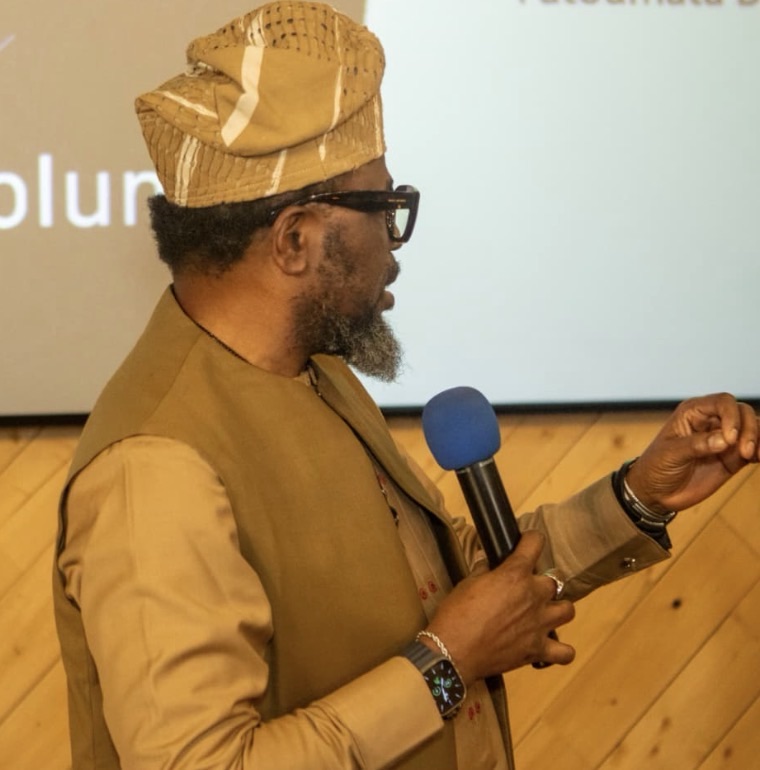
My leadership story is the story of the stone the builders rejected, seizing every moment until it could no longer be ignored
In the beginning, I was never anointed by man into leadership; yet I was anointed by God before the world began.
My journey did not follow the familiar path of appointment, preference, or institutional approval.
In primary and secondary school, I was never a class captain, never a prefect, never chosen.
I was the opposite: the “noise-maker,” the “disturber,” the boy nicknamed “devil” at age ten, the student whose name entered the black book by Class Two.
Leadership did not call me.
I called leadership.
My first experience of leadership by popular mandate came at Lagos State University, when I ran for Director of Welfare, won, and served under my president, then and even now, Dele Farotimi, my only electoral victory to date. I ran for SUG President and lost. I ran for NANS President, travelling across Nigeria by night, risking robbery, accidents, and harmattan weather, and lost again.
I have lost more elections than I have won,
but I have never lost my leadership.
These experiences taught me a foundational truth:
Leadership is not a title. Leadership is responsibility.
This informed my philosophy that our precious children are not “leaders of tomorrow”; they are leaders of today, because leadership begins the moment one chooses responsibility.
My own sense of responsibility was born from pain. I grew up in an abusive home, physical, emotional, sexual abuse, and deep neglect.
When I became an attorney in 1999, I sensed a mandate: to build a world fit for children in Africa and beyond. My childhood experiences had prepared me for a constituency society routinely neglected. I did not wait for appointment or anointment. I stepped forward.
It cost me something.
Leadership always costs something.
I turned down an offer from Chief Gani Fawehinmi’s chambers, the largest in Nigeria at the time, led by the man who magnanimously funded my education. Refusing that comfort was painful but necessary. I stepped out of privilege into a self-chosen fellowship of suffering because I saw a path I needed to lead.
In The Guardian of Friday, December 3, 1999, in my article “The Lawyer as a Crusader,” I declared my intention: to place the rights and responsibilities of the African child at the centre of public conscience and consciousness.
That was my leadership.
And leadership, I have learned, is often seized, not given.
- THE GHANA EXPERIENCE, WABA CONFERENCE
Barely a year at the Bar, by sheer providence, I joined Nigeria’s delegation to the West African Bar Association conference in Ghana, invited by Mr. Nurudeen Ogbara. Mr. Femi Falana was contesting for office.
I attended like every other delegate but contributed wherever I sensed a gap. By the third day, I discovered an African women lawyers’ conference holding nearby. During a break, I slipped in, made contributions, and returned to WABA.
When I returned, the Nigerian delegates met me with urgency:
“We’ve been looking for you.
We need you to second our candidate’s nomination.
Your relevance here makes it necessary.”
On the return trip, Mr. Kayode Stephen Adaramoye, a senior and respected colleague told me:
“You are only one year at the Bar, but from what I’ve seen, and from your work with children in Lagos, Nigeria must watch out for you.”
That moment confirmed something I already sensed:
Leadership is not position. Leadership is presence.
- THE UNICEF–BAR COUNCIL OF ENGLAND AND WALES
UNICEF invited Bar of England and Wales delegates to collaborate with Nigerian experts on a national case-management model. The UK team suggested that when local systems fail, Nigeria should rely on foreign intervention.
I stood up and disagreed, not to impress, but because international intervention is driven by interest, not compassion. I cited Syria, Rwanda, Bosnia, contexts where global politics halted meaningful action.
The room shifted.
The UK team had no answer.
Nigerian partners scolded me during the break for “embarrassing” them.
I approached the project manager, Ms. Noriko Izumi, the reprenstive of UNICEF:
“Was my critique wrong?”
Her reply stunned the room inside me:
“That is why we brought you. I saw these things firsthand in Kosovo.”
She asked if I consulted. I said yes.
Days later, I was contracted to join a team of leading national and international experts, led by Child Frontiers, to map family-service structures in Lagos State, work that ultimately shaped the frameworks later adopted.
Leadership seized.
- THE AMERICAN COORDINATOR, PRISON REFORM PROJECT
At a UNICEF prison-reform workshop, the first session was rowdy; participants were not paying attention to the American consultant leading the program.
After the break, without asking permission, I walked to the front, restored order, and guided the session strictly by the agenda. She stepped back and allowed it.
The next morning, she approached me:
“Who are you?
Anywhere I conduct this program in Nigeria, you must come with me.”
That is how I joined UNICEF’s Prison Reform initiative and met transformative leaders in the justice sector.
Leadership seized.
THE TRUTH ABOUT LEADERSHIP
Leadership is situational.
Leadership is responsibility, not ritual.
You do not need election, anointment, appointment, or endorsement.
And as Nigeria shows daily, being elected does not make anyone a leader.
If you are a leader, you will lead:
before appointment,
without appointment, and
beyond appointment.
Election merely provides a platform.
It does not create the leader.
My life has taught me one enduring truth:
Power does not shift except to superior power.
And superior power is responsibility.
Every opportunity I encountered, I seized.
Every room I entered, I contributed.
Every vacuum I found, I filled.
That is leadership.
What is your own experience of leadership?
Do have an INSPIRED weekend with the family.

