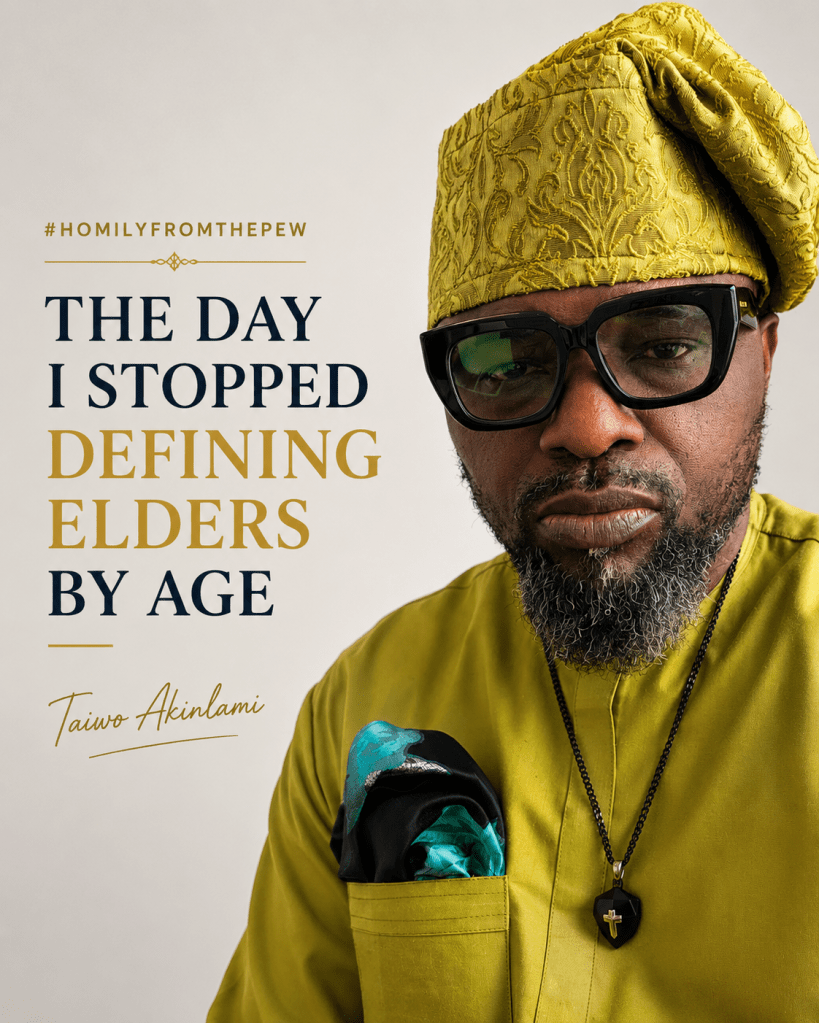
HomilyFromThePew
“The greatest evidence of true eldership is not that people obey you. It is that they can safely trust you.”
— Taiwo AKINLAMI
There are questions that arise from curiosity.
There are others that arise from disappointment.
Mine belongs to the latter.
For quite some time now, one question has refused to leave me.
Who truly is an elder?
I did not arrive at this question as an academic exercise.
Life compelled me to ask it.
Over the years, I have been privileged to encounter remarkable men and women whose wisdom, sacrifice, integrity, and courage have profoundly shaped my life. I remain deeply grateful to God for them. They are among His greatest gifts to me.
Yet I have also experienced something else.
Some of the deepest disappointments of my life have come from people I regarded as elders.
Not merely people older than I.
Elders.
Men and women whose age, influence, public reputation, spiritual standing, or office led me to believe they would naturally embody wisdom, justice, fairness, restraint, and truth.
Those experiences wounded me.
They could easily have shaken my faith.
But they did not.
Why?
Because my faith has never been anchored in human beings.
Long before disappointment found me, Scripture had already redirected my gaze.
“Looking unto Jesus the author and finisher of our faith.”
— Hebrews 12:2
That single truth preserved me.
Christ is the foundation of my faith.
Human beings, however respected, are not.
Yet those experiences compelled me to revisit a question I had never carefully examined.
What actually makes someone an elder?
Is it merely the number of years one has lived?
The grey hair one has acquired?
The office one occupies?
The title that precedes one’s name?
Or has God always intended something much deeper?
As I searched the Scriptures, my mind returned to a passage that had arrested me in my early years as a believer and remained tucked away in the guarded corners of my heart—the conversation between Job’s elderly friends and a young man named Elihu.
His words arrested me afresh.
After patiently allowing the older men to speak, Elihu said:
“I thought, ‘Age should speak; advanced years should teach wisdom.’ But there is a spirit in a person, the breath of the Almighty, that gives them understanding. It is not only the old who are wise, nor the aged who understand what is right.”
— Job 32:7–9
What an extraordinary insight.
Elihu did not despise age.
He honoured it.
He simply refused to confuse age with wisdom.
That distinction changed the way I read Scripture.
It also changed the way I view leadership, influence, and eldership.
Then something even more beautiful occurred to me.
Long before I rediscovered Elihu’s words, my Yoruba heritage had been teaching me the same lesson through the wisdom of my paternal grandmother, Mama Aina Comfort Akinlami. She spoke almost entirely in proverbs. Many of the insights I have shared over the years owe much to her quiet but profound influence.
The Yoruba say:
“Àgbàlagbà tó so yàngàn mọ́ ìdí, ó ti sọ ara rẹ̀ di ojúgbà adìẹ.”
Literally,
“An elder who ties corn around his waist has made himself equal to the chicken.”
The imagery is unforgettable.
The elder himself has invited the chickens.
By his own conduct, he has surrendered the dignity that ought to accompany eldership.
The proverb teaches a timeless truth.
Conduct sustains honour.
Age alone does not.
That became a defining moment for me.
I realised that while the Bible commands me to honour age, it never commands me to surrender discernment.
So I made a covenant with myself.
I will honour every human being because every human being bears the image of God.
I will honour older people because Scripture commands me to do so.
I will respect those who occupy positions of authority because order matters.
But I will never again surrender my judgment, my conscience, my confidence, or my followership merely because someone is older than I am or occupies an influential position in a religious or secular institution.
Trust must be earned.
Moral authority must be cultivated.
Followership must be deserved.
For me, an elder is no longer defined merely by age.
An elder is recognised by the content of his or her character.
An elder loves truth more than convenience.
Justice more than personal interest.
Relationships more than reputation.
Principle more than popularity.
An elder is humble enough to apologise when wrong.
An elder is wise enough to hear all sides before reaching conclusions, remembering the wisdom of Scripture:
“The one who states his case first seems right, until the other comes and examines him.”
— Proverbs 18:17
The Yoruba express the same truth:
“A gbọ́ ẹjọ́ ẹnu ẹni kan dá, àgbà òṣìkà ni.”
“The elder who decides a matter after hearing only one side acts with great wickedness.”
An elder is strong enough to sacrifice personal gain for the common good.
An elder does not traffic in rumours.
An elder does not weaponise influence.
An elder does not become an agent of hurt.
An elder, after the manner of Christ, seeks first to heal hearts and restore relationships. He understands that lasting institutional health is never built upon broken people, injustice, or campaigns of suspicion. He is more interested in restoration than retaliation.
An elder understands the limits of his or her authority.
He honours due process.
He respects the terms of reference of his stewardship.
He refuses to manipulate people through intimidation, deception, or campaigns of calumny.
An elder embraces decency and decorum.
He disagrees without becoming disagreeable.
As Solomon wisely observed:
“Be not quick in your spirit to become angry, for anger lodges in the bosom of fools.”
— Ecclesiastes 7:9
An elder is quick to hear, slow to speak, and slow to become angry (James 1:19).
An elder reads the room.
He is circumspect in speech and conduct.
He is sensitive to the hearts of people and the moment in which he speaks.
He is known for a word in season because he is governed by the wisdom that comes from above:
“But the wisdom from above is first pure, then peaceable, gentle, open to reason, full of mercy and good fruits, impartial and sincere.”
— James 3:17
Like the Apostle Paul, an elder knows how to become “all things to all people” for the sake of winning hearts without compromising truth (1 Corinthians 9:22).
The Yoruba also say:
“Àgbàlagbà kì í ṣe ọ̀rọ̀ bí ewé.”
An elder does not speak or behave with the immaturity of a child.
Neither does an elder dishonour an authority to whom he professes submission simply because that leader is younger.
Wisdom distinguishes the office from the officeholder and accords each the honour due.
As another Yoruba proverb teaches:
“Ibi tí a bá pè ní orí, a ò fi tẹ ilẹ̀.”
“What we call the head is not what we use to tread upon the ground.”
An elder does not flaunt age as the reason he should be respected.
He puts character forward.
He understands the wisdom of Scripture:
“It is not glory to seek one’s own glory.”
— Proverbs 25:27
Perhaps our greatest crisis today is not that we have too few older people.
Perhaps it is that we have too few elders.
We have multiplied titles without multiplying wisdom.
We have celebrated longevity without demanding integrity.
We have confused seniority with maturity.
We have mistaken influence for moral authority.
We have revered position while neglecting character.
So, I have made my choice.
I choose to honour age.
I choose to pursue character.
I choose to seek wisdom.
I choose to follow Christ.
Because in the end,
Age deserves honour.
Character deserves trust.
Wisdom deserves followership.
Christ alone deserves worship.
Do have an INSPIRED week ahead with the family.
⸻
Adapted from Chapter One of my forthcoming book, The Content of an Elder: Rediscovering Biblical Eldership in an Age of Gerontocracy.

