VITAL OBITER®
“The Nation Is Bleeding” and the Spirit of Niemöller Echoes: From My Lord Spiritual to My Lord Temporal
Permit me to open with the appropriate ceremony, for this is a matter of high protocol.
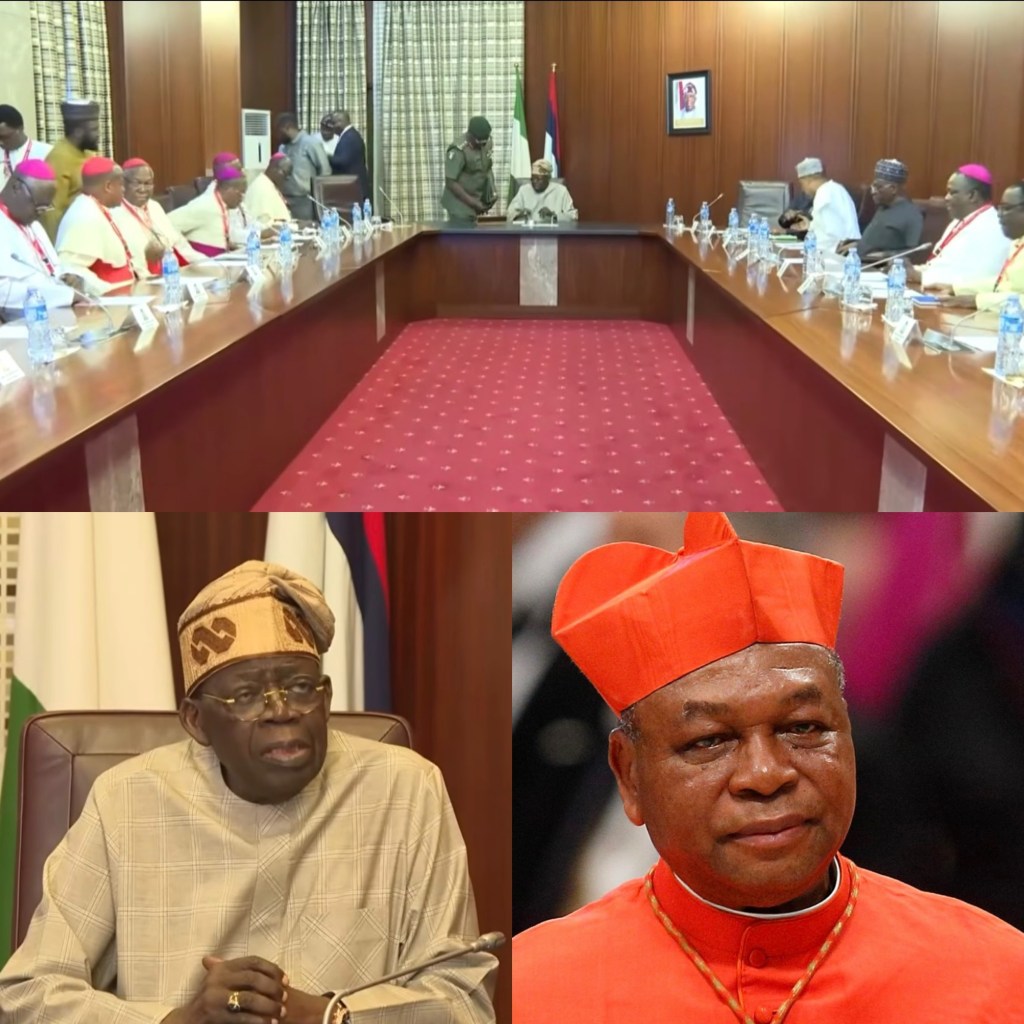
On a Tuesday in this our season of discontent, the twenty-eighth of July, in the year of our Lord 2026, a delegation of My Lords Spiritual, being the venerable Catholic Bishops’ Conference of Nigeria, presented themselves at the palace of My Lord Temporal, to deliver unto him a message.
And what a message. “Our nation is bleeding,” they said. “The citizens are suffering and crying.”
Now, I must pause here for the benefit of my gentle reader, because this is not the manner of message My Lord Temporal is accustomed to receiving.
My Lord Temporal has been, these many seasons, a most generously pampered recipient of adulation, a throne to which My Lords Spiritual have processed in long and fragrant lines, bearing incense, bearing laurels, bearing the sweet liturgy of “Mr. President, you are the one ordained, like Esther, for such a time as this.” He has heard it so often, and from so many mitres, that one could forgive him for having come to believe it himself.
So when this particular company of clergymen opened their mouths, and out came lamentation where he had reasonably expected laurels, one imagines the royal eyebrow climbing toward the royal hairline. A grave misprofiling had occurred. Somebody in protocol will answer for it.
But let me not get ahead of my licence. For what do I know? I am merely a public-interest roving counsel, indeed, the self-appointed Chief of Opata, that ancient Lagos office reserved for those of us who will not stop yarning our irrelevances even when wiser men beg us, ‘abeg, no yarn me opata.’
Yet even the Chief of Opata sees what he sees. And what My Lords Spiritual did that day is, in truth, the oldest office in the sacred book.
It is the office of Nathan, who walked into David’s palace, David, the anointed, the giant-killer, the man after God’s own heart, and said to his face, thou art the man.
It is the office of Elijah, who stood before Ahab and was greeted as the troubler of Israel, and answered that it was not he who troubled Israel, but the king.
It is the office that cost John the Baptist his head, because he would insist, at Herod’s own table, that a thing unlawful remained unlawful even when a king enjoyed it.
The role of My Lord Spiritual before My Lord Temporal has never been to burnish the crown. It has been to tell the crown the one thing the courtiers are too comfortable, too fed, and too frightened to say.
And so these bishops said it.
They spoke of a bleeding nation.
They spoke of the ninety and more souls freshly cut down in Kaduna and Benue and Plateau, whose blood had not yet dried when the delegation set out.
They spoke of hardship that will not lift, of a political space growing narrower by the season, of the gathering dread of a one-party house, of an election in 2027 whose credibility now keeps honest people awake.
They came, in short, not to flatter the throne but to hold a mirror before it.
And how did My Lord Temporal receive his reflection?
He informed the good bishops, we are reliably told by no less than Cardinal Onaiyekan, that the nation is not bleeding.
That the economy is, in fact, doing fine.
That the picture is rosy.
And mark the messenger well, gentle reader, before the palace teaches you to distrust him. Cardinal Onaiyekan is eighty-two years old, an emeritus prince of the Church who long ago laid down every office a climbing man might still be angling for.
What, pray, does a man of eighty-two, at the twilight of a life already crowned, stand to gain by making an enemy of a palace?
Ambition is the young man’s disease.
This was something older, and far rarer: a clear conscience with nothing left to lose.
The Cardinal, being a candid man, added the detail that there are courtiers hovering about the throne whose full-time vocation is the painting of precisely such rosy pictures, and that the bishops had come, at some inconvenience to the mood of the room, to paint a truer one.
As His Eminence put it with a bluntness I could never dare, when a nation is bleeding one cannot expect a polite meeting.
The palace, for its part, was not amused. Within days the Presidency had returned its verdict:
the Cardinal had breached confidentiality;
the Cardinal was partisan;
the Cardinal was, in effect, running errands for the opposition.
Which is to say, when the mirror shows an unflattering thing, the modern remedy is not to adjust the face. It is to indict the mirror.
But what do I know? I am only the Chief of Opata, ambling through the republic on my licence, trying to make sense of what is placed before me.
I salute the College of My Lords Spiritual for the visit, for it was no comfort-zone conversation, and it will cost them the warmth of the palace. I only observe that from this day forward, My Lord Temporal may wish to vet his visiting clergy more carefully, lest another delegation slip past protocol bearing truth instead of tribute.
And here, do forgive this my wandering mind, for you know by now how it works, my thoughts drifted to another clergyman, in another country, in a darker hour. Pastor Martin Niemöller, who watched a regime come for one group, and then another, and then another, while the respectable and the comfortable said nothing, each consoling himself that it was not yet his turn to be afraid. Niemöller’s warning was not about the men who spoke. It was about the men who stayed silent, until the silence arrived, at last, at their own door, and found no one left to break it.
Am I comparing My Lord Temporal to any tyrant? God forbid. Who am I, a bloody Chief of Opata, to place such a thing in my own mouth? I draw a parallel; nothing more.
That is simply the example my mind reached for, and I have voiced it as it came, so let no one twist it, and let no one hang my poor barking dog merely because they have first taken the trouble to give it a bad name.
I only note the sharp little irony at the heart of the whole affair. In Niemöller’s tragedy, the guilty were the silent.
And in our own scene, the many My Lords Spiritual who processed to the palace across the years bearing only praise, they were the silent ones, however loudly they sang. It was these few bishops, arriving with lamentation, who finally broke the silence.
So the question I leave upon the table, mere opata, of course, from the Chief himself, and then I shall withdraw upon my licence, is a simple one.
Of all the My Lords Spiritual who have entered that palace, and all who are yet to come, how many arrived to break the silence, and how many merely to perfume it?
The court will rise.
Vital Obiter®, the roving counsel reserves the right to be wrong, but not to be silent.

