HOMILY FROM THE PEW
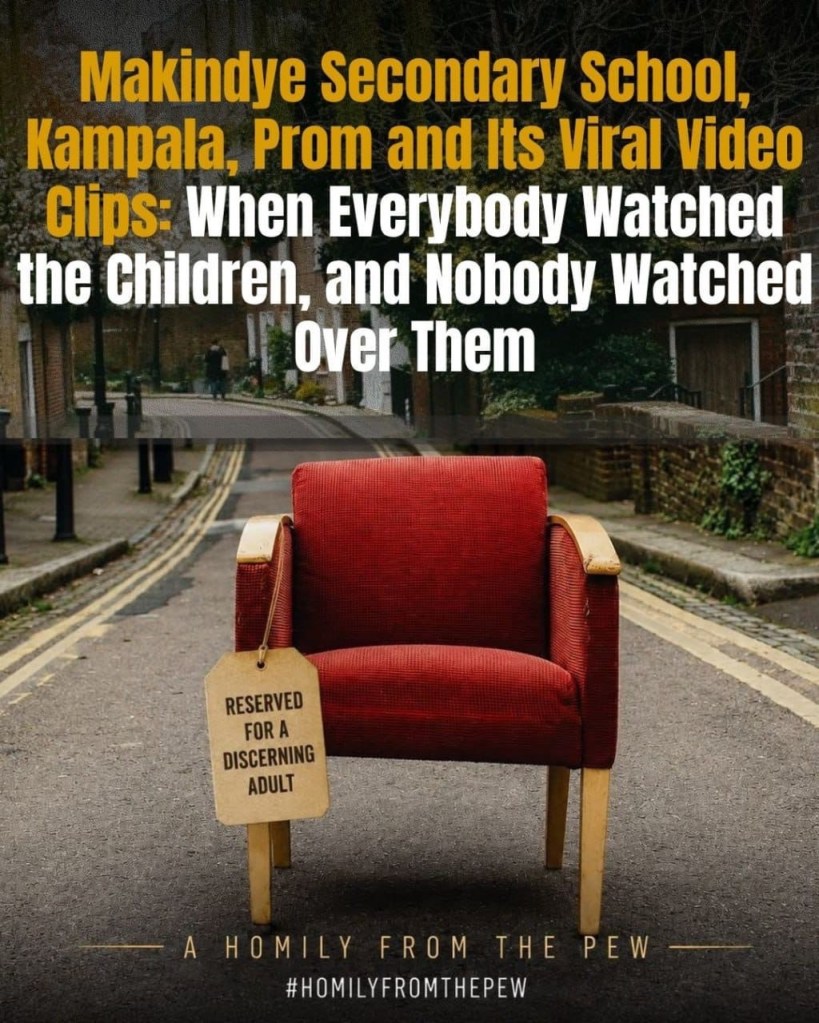
On the Makindye prom and the difference between being watched and being watched over.
I write this from the pew, not the pulpit.
Some news reaches you differently there.
This did.
A school prom at Makindye Secondary School, Kampala, is on a viral voyage across Africa and beyond, enthusiastically reshared by both friends and foes of the souls of our precious children.
The widespread circulation of those video clips, and what it means for the dignity, privacy, and future of the children involved is a conversation for another day.
In fact, that day is tomorrow, Monday, August 3, 2026 in our Family Law for the Streets series.
But today’s concern is different.
The theme of the prom was Africa Herself: Into the Motherland.
Before we say one hard word, let us first be fair.
There was genuine creativity on that carpet.
Banana leaves folded into couture. Old newspapers transformed into flowing gowns. Coral beads. Cowries. Raffia. Intricate beadwork that could only have been produced by patient hands over long hours.
That is imagination.
That is teamwork.
That is young people creating beauty in a world that constantly tells them to innovate.
Had the evening ended there, we would have had nothing to say except:
“Well done.”
We would simply have applauded.
But the carpet did not stop at creativity.
Somewhere along that red aisle, children—that is, anyone below the age of 18—were dressed as glamorous adults, styled and posed for the gaze of a world they have not yet entered.
Somewhere along that same aisle, children appeared in costumes that exposed significant portions of their developing bodies and presented them in ways more readily associated with adult fashion and the adult gaze.
Let me be clear.
My concern is not modesty as a dress code.
My concern is safeguarding as a culture.
Childhood is not a rehearsal for adulthood.
It is a season worthy of its own dignity, beauty, and protection.
Children should not be invited to borrow adult identities simply because adults applaud them.
When adults design, approve, or celebrate presentations that prematurely adultify or sexualise children, we must pause, not to condemn the children, but to examine our own judgment.
The question is not merely whether the child looked beautiful.
The deeper questions are:
Beautiful for whom?
Admired by whom?
And through whose eyes were we asking that child to see himself or herself?
Somewhere along that aisle, children were also presented as visibly pregnant.
Whether the intention was theatrical, symbolic, artistic, or based upon a fictional character is not my immediate concern.
My concern is different.
Childhood and pregnancy do not naturally belong together.
A visibly pregnant child is not merely a costume.
It is an image that inevitably touches one of the gravest child-safeguarding concerns of our time: child sexual abuse and child or teenage pregnancy.
I am not suggesting that the organisers intended to promote either.
I am asking a safeguarding question:
Should adults deliberately invite children to embody realities that safeguarding professionals spend their lives trying to prevent?
The issue is not whether the costume was creative.
The issue is whether it was wise.
Somewhere along that same aisle, children were dressed as the dead.
Skulls.
Shrouds.
The grave.
Even a coffin carried down the carpet as entertainment.
Somewhere along that aisle appeared the imagery of the sword, the conqueror, and the one kneeling beneath him.
And the safeguarding question is not:
“Were the children creative?”
Of course they were.
The real questions are these:
Who dressed them?
Who conceived the brief?
Who reviewed the plan and finally said:
“Yes. Let a child walk this carpet as a corpse, visibly pregnant, or styled for the adult gaze, and let the world watch.”
Hear me carefully.
The child is not the problem.
A child’s imagination is one of God’s precious gifts.
It reaches.
It stretches.
Sometimes it even overreaches.
That is part of childhood.
The imagination did not fail.
The adults did.
Scripture says:
“Train up a child in the way he should go…”
(Proverbs 22:6, KJV)
Notice where God places the responsibility.
Not upon the child.
Upon the adult entrusted with the child.
The failure was the empty chair where a discerning adult should have been sitting.
Someone designed it.
Someone approved it.
Someone dressed them.
Someone filmed it.
Someone uploaded it.
Someone counted the likes.
Every gate has a gatekeeper.
This gate had one too.
But the gate was not kept.
And here is the part we are not discussing enough.
Every frame carried a watermark.
Every child acquired a permanent digital footprint.
Likes.
Comments.
Shares.
Views.
Numbers climbing while they walked.
These are children.
One evening has now become permanent digital history, travelling farther than any of those children can ever retrieve, into homes they will never enter, before audiences they will never meet, for years they have not yet lived.
Even before we debate costumes…
Even before we debate themes…
That alone is a child-safeguarding concern.
Children cannot meaningfully appreciate the lifelong consequences of becoming permanent global content.
Neither can they fully appreciate what it means for images of their developing bodies to become permanent digital artefacts, capable of being viewed, copied, altered, circulated, and consumed by audiences far beyond the event itself.
Neither can they give informed consent to becoming enduring online entertainment for adult consumption.
That responsibility belongs to adults.
Safeguarding begins where adult foresight meets childhood innocence.
There is a principle I have carried for many years.
An old friend once named his son an entire sentence:
“The community is watching me.”
In Yoruba:
“Ìlú ń wò mí.”
I often used it as a reminder that public life demands accountability.
Conduct yourself well.
People are watching.
But Makindye has taught me to hear that sentence differently.
Because there is a profound difference between being watched…
…and being watched over.
To be watched is simply to be seen.
To be watched over is to be protected.
To be watched is to attract attention.
To be watched over is to receive loving responsibility.
Scripture knows that difference.
“Behold, he that keepeth Israel shall neither slumber nor sleep.”
(Psalm 121:4, KJV)
“The LORD is thy keeper.”
(Psalm 121:5, KJV)
The Psalmist is not merely describing God’s sight.
He is describing God’s guardianship.
That is what it means to be watched over.
An eye that loves.
An eye that never sleeps.
An eye that stands between the child and harm.
On that carpet, the children were watched by thousands.
Now, perhaps, by millions.
But too few were truly watched over.
So what do we do?
The easy answer is always the loudest one.
Ban school proms.
Issue another regulation.
Punish somebody.
That is enforcement.
Necessary sometimes.
But insufficient by itself.
Enforcement may stop an event.
It cannot, by itself, cultivate wisdom.
There is a higher answer.
It is quieter.
It is slower.
But it is deeper.
Enlightenment.
A thoughtful adult asking two simple questions before a child ever steps onto the carpet:
Who are we asking this child to become, even if only for one night?
Who might this child remain online for the rest of his or her life?
Those questions are no longer theoretical when a child is invited to portray pregnancy, death, conquest, submission, or adult sexuality.
Every costume teaches.
Every role forms.
Every applause reinforces.
Answer those two questions honestly, and much of that programme redesigns itself without the need for a single prohibition.
That is why I continue to insist:
Enlightenment Is Superior to Enforcement®
So let no one place these children on trial.
They simply did what children are meant to do.
They imagined.
Instead, let us examine the adults.
The designers.
The organisers.
The approvers.
The photographers.
The videographers.
The publishers.
The adults who counted the likes without weighing the lifelong implications.
So let us ask, gently, but without flinching, the only question that truly matters wherever a child has been left uncovered:
Where were you when everybody was watching… and nobody was watching over?
Because children do not merely need an audience.
They need keepers.
Think the CHILD… Think TODAY… Think the FUTURE®

