HOMILYFROMTHEPEW
I began worshipping at The Fountain of Life Church on 18 February 1997.
A few years later, a gentleman caught my attention.
We called him Mr. Ben.
Sometimes Brother Ben.
And strangely, for more than twenty years, that was almost all the identifying information I had about him.
I never knew his surname.
I did not know where he lived.
I am not certain what he did professionally, although I seem to remember him saying that he had once worked as a clerk in a law firm.
He spoke good English and would occasionally throw legal expressions into conversations, almost jocularly.
I never knew him to be married or to have children. But there was much about Mr. Ben’s private life that I simply did not know.
He was not a recluse.
He was not invisible.
Many people in church knew him.
Mr. Ben was simply around.
He came to church.
He worshipped.
He spoke with people.
Sometimes he communicated a need, and those who could offered whatever support they could.
And there was one thing about him that has returned very strongly to me since I heard that he had passed.
His smile.
Mr. Ben smiled.
There always seemed to be a smile somewhere on his face.
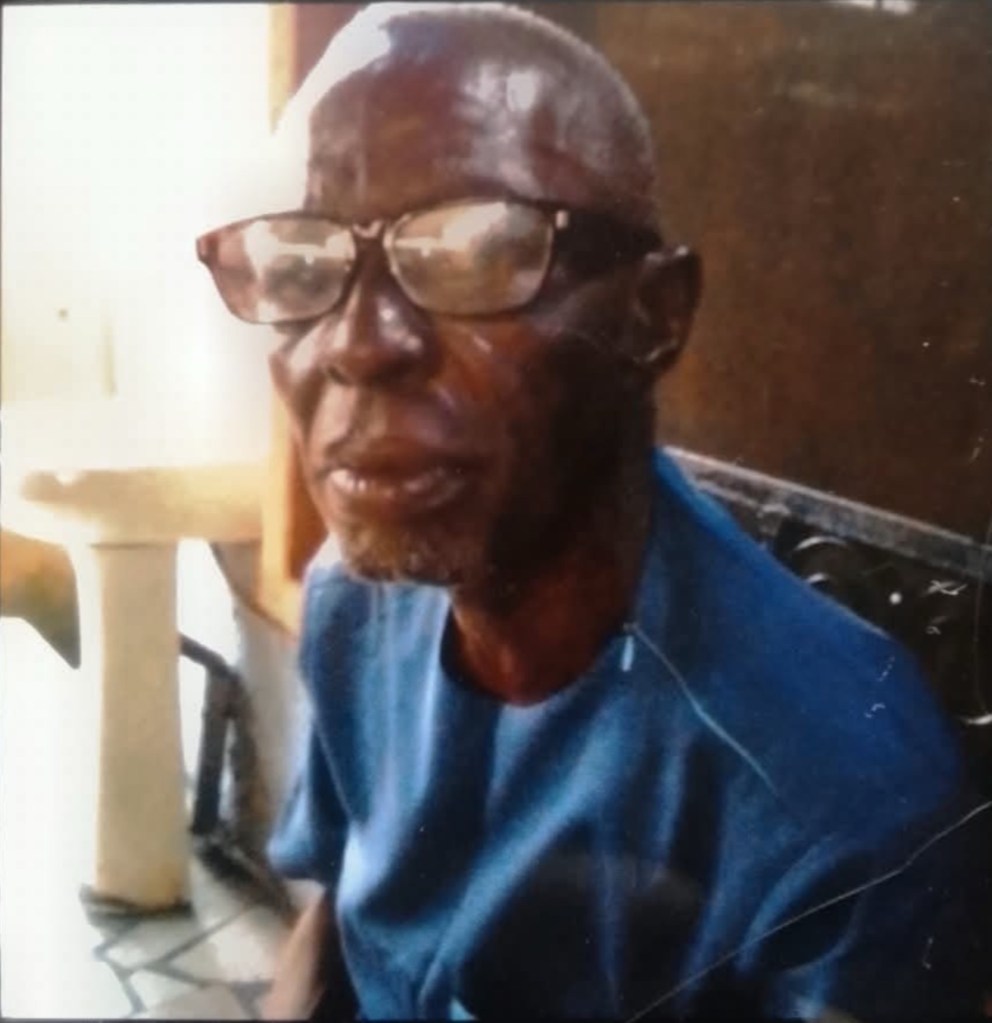
I was also convinced that I did not have a single photograph of him.
Then, while writing this reflection, I randomly asked my twin brother Kehinde Akinlami whether he happened to have one.
Surprisingly, he did.
Years ago, my brother had been taking photographs of his children in church, and Mr. Ben simply wandered into one of the pictures.
Nobody was photographing him.
He was not the subject.
Nobody arranged the camera for him.
He simply happened to be there.
And somehow, that photograph has become a metaphor for the Mr. Ben I remember.
He was there.
Quietly.
Unceremoniously.
Part of the human traffic of our church community.
Now, years later, an accidental photograph has become precious because the man who wandered into the frame is no longer here.
Perhaps that is how many human lives appear in the larger photograph of history.
They are not at the centre.
Nobody arranges the camera for them.
Nobody asks them to pose.
They enter the frame, occupy their little space in the human story, and eventually move on.
But being at the edge of the photograph does not make a human life less valuable than the person standing at its centre.
I am told that Mr. Ben passed following complications from prostate cancer.
And since hearing the news, one question has refused to leave me:
What is the meaning of this life?
What kind of eulogy do you write for a man whose surname you never knew?
I cannot tell you that Mr. Ben built great institutions.
I cannot point to public accomplishments, professional distinctions, wealth, influence, or some celebrated legacy attached to his name.
That was not the Mr. Ben I knew.
And perhaps our discomfort with a description that ordinary is precisely the point.
Why must I find something extraordinary that Mr. Ben did before I can say that his life mattered?
Perhaps we have developed a rich vocabulary for celebrating achievement, but very little vocabulary for affirming the worth of an ordinary human life.
There is nothing wrong with achievement.
We should strive.
We should build.
We should serve.
We should deploy our gifts and leave the world better than we met it.
But is achievement what gives a human life its worth?
Jesus warned:
“A man’s life consisteth not in the abundance of the things which he possesseth.”
Luke 12:15, KJV
Perhaps that warning reaches beyond possessions.
A man’s life does not consist merely in the abundance of his achievements either.
And that brings me to Rufus.
Except Rufus was not Rufus.
At least, we do not know that he was.
Many years ago, Dr. Adebayo Williams wrote an article titled Remembering Rufus in Tempo.
As I remember that powerful piece, Dr. Williams encountered the lifeless body of an unidentified man left on a Lagos street in the aftermath of the protests that followed the June 12 crisis.
Nobody seemed to know his name.
Dr. Williams did not know him.
He did not know where he came from.
He did not know whether he had a wife, children, dreams, failures, wealth, poverty, or any achievement society would consider remarkable.
He was simply a lifeless human body on the street.
And Dr. Williams christened him Rufus.
Then he wrote:
Remembering Rufus.
Think about that.
A man whose real name was not even known had to be given a name so that we might stop long enough to consider the life that had been taken.
Rufus did not need an impressive biography before his death became a tragedy.
We did not need to discover a title, a mansion, a university degree, a business, an institution, or a list of accomplishments.
He was a man.
That was enough.
The worth of a man’s life does not begin with what the man has done with his life.
It begins with the fact that there is a life.
A human life.
Created by God.
Bearing a dignity that achievement did not give and failure cannot take away.
And perhaps this is why, decades after reading about a dead man whom Dr. Williams called Rufus, I find myself remembering him again because another seemingly ordinary man has died.
This time, I knew his name.
Mr. Ben.
And that raises another question.
What happens to the person who, for whatever reason, cannot hold his own life together?
The person whom circumstances have beaten down?
The person who never functions at what society calls his full potential?
Does that life become meaningless?
Does God say, “You malfunctioned. You failed to become everything I intended. Therefore you have no value”?
If that were the Gospel, why did Christ come?
“For all have sinned, and come short of the glory of God.” Romans 3:23.
All.
At one level or another, we are all malfunctioning.
Some malfunction is obvious.
Some is polished.
Some hides beneath titles, wealth, accomplishments and standing ovations.
Christ did not come because humanity was functioning perfectly.
He came because we were not.
“But God commendeth his love toward us, in that, while we were yet sinners, Christ died for us.” Romans 5:8.
While we were yet.
Not after we fixed ourselves.
Not after we became impressive.
Not after we fulfilled our potential.
While we were yet.
That changes how we measure human worth.
Achievement does not create dignity.
Usefulness does not create dignity.
Recognition does not create dignity.
The funeral does not create dignity.
The monument does not create dignity.
The worth was already there.
Because the life was already there.
Death will eventually level all of us.
The celebrated will go.
The obscure will go.
The billionaire will go.
The person who never had enough will go.
And eventually, even those doing the remembering will themselves need to be remembered.
So today, like Rufus, I remember Mr. Ben.
Not because I can catalogue his achievements.
I remember him because he lived.
Because he was part of us.
Because he smiled.
Because, somehow, for more than twenty years, our paths crossed.
Jesus said:
“Are not five sparrows sold for two farthings, and not one of them is forgotten before God?”
Luke 12:6, KJV
Not one forgotten.
Perhaps heaven’s register of significant lives looks very different from ours.
Perhaps there are people the world barely noticed whom heaven never overlooked.
Perhaps there are people who stood at the edge of our photographs but were never at the edge of God’s attention.
Mr. Ben, I never knew your surname.
But your departure has made me think deeply about life.
And now I even have your photograph.
You were not posing.
You were not the subject.
You simply wandered into the frame.
Perhaps that photograph says it all.
You were here.
You occupied your place in the frame.
You occupied your place among us.
You occupied your place in the human story.
And you did not need to become famous before your life acquired value.
Rest well, Mr. Ben.
I remember you today.
And I remember Rufus too.
Because a human life is valuable before history ever decides whether to record it.
Do have an INSPIRED week ahead with the family.
Think LIFE…
Think WORTH…
Think ETERNITY.
MinistryofClarity
Follower of Christ. Husband. Father. Egalitarian. Goodwill Investor. Attorney. Author. Thriver. Culture-Edge Family Strengthening and Child Safeguarding Pioneer, Innovator and Practitioner. Value-Based Parenting Ideologue. Change Agent. Rebel with a Cause. Three Decades in the Saddle.

