VITAL OBITER®
I have been thinking.
Perhaps we have finally arrived.
Perhaps Nigeria has become a First World country and nobody remembered to announce it.
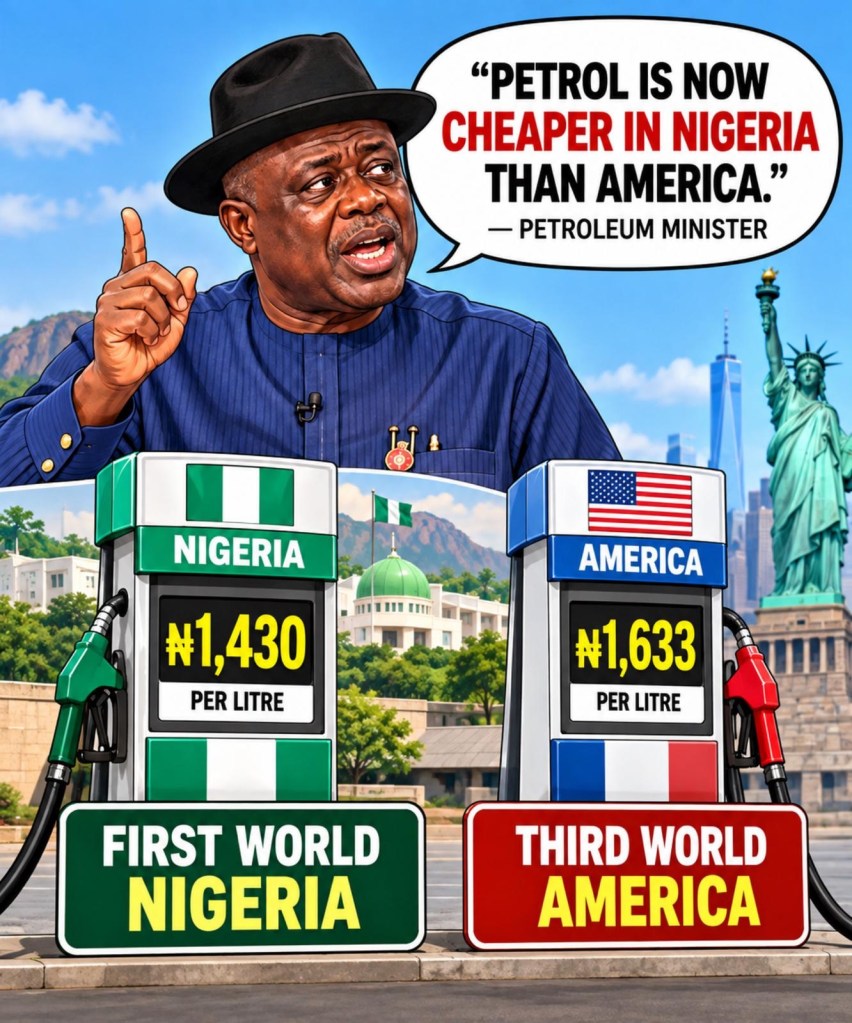
Nigeria’s Minister of State for Petroleum Resources (Oil), Senator Heineken Lokpobiri, recently told Nigerians that petrol is cheaper here than in the United States.
According to the figures he cited, petrol averaged about ₦1,430 per litre in Nigeria, compared with a naira equivalent of about ₦1,633 per litre in America.
Wonderful.
So what exactly are we supposed to do with this information?
By this singular economic index, has Nigeria overtaken America?
Is the Nigerian economy now stronger than the American economy?
Has Nigeria become First World while America quietly descended into Third World?
Of course not.
And that is precisely the problem.
A statistic may be numerically correct and still tell a thoroughly misleading story when stripped of context.
Price is not affordability.
If bread costs ₦1,000 to a man earning ₦70,000 and ₦2,000 to another earning ₦7 million, you may truthfully say:
“Bread is cheaper for the first man.”
Wonderful.
But which of them can better afford bread?
That is where context enters the room.
The economically meaningful question is not merely:
How much does one litre of petrol cost after converting dollars into naira?
It is:
What proportion of the buyer’s income does that litre consume?
What is his purchasing power?
What does transportation consume from his income?
Food?
Housing?
Healthcare?
Electricity?
Education?
And after paying for these necessities, what remains?
Only then have we begun an economic comparison.
And while we are brandishing figures, perhaps we should brandish some Nigerian figures too.
The National Bureau of Statistics’ 2022 Multidimensional Poverty Index found that 133 million Nigerians, 63% of the population measured were multidimensionally poor. The deprivations included sanitation, healthcare access, food security, housing and cooking fuel.
But there is a figure that troubles me even more.
Children.
According to that same NBS report, Nigeria had almost 100 million children aged 0–17. 67.28 million of them, 67.5% were multidimensionally poor.
Two out of every three Nigerian children.
Indeed, children constituted 51% of all multidimensionally poor Nigerians.
UNICEF’s 2024 Situation Analysis continues to cite that 67.5% child-poverty figure and reports that almost 90% of rural children experience multidimensional poverty.
Those are Nigerian figures too.
Why don’t we brandish them with the same enthusiasm?
This reminds me of another remarkable comparison from government circles.
In July, presidential adviser Daniel Bwala argued that a Nigerian earning ₦60,000 could, in some respects, be better off than a Nigerian in Britain earning £2,600–£2,800 monthly because much of the British income disappears into living expenses.
Again:
One figure.
One comparison.
One conclusion.
But economies do not work like that.
The Nigerian earning ₦60,000 eats.
Travels.
Finds accommodation.
Pays electricity bills.
Where electricity fails, he may pay again to generate his own.
He pays for healthcare.
Education.
Water.
Security in some places.
And somehow survives inside the same economy whose multidimensional poverty figures government itself has published.
There is nothing wrong with comparing Nigeria with America.
There is nothing wrong with comparing Nigeria with Britain.
We should.
But comparison is an intellectual exercise. It should not become a propaganda exercise.
You cannot select the one number on which Nigeria happens to look better, remove income, purchasing power, poverty, productivity, infrastructure and household welfare from the picture, convert everybody’s currency into naira and announce victory.
Otherwise, economics becomes very easy.
Find something cheaper in Nigeria than America.
We have overtaken America.
Tomorrow, find something cheaper here than Switzerland.
Switzerland, sorry. We have passed you.
Next week, Norway.
At this rate, before Christmas, Nigeria may become the most developed country on earth.
The painful part is that this is a country of intellectuals.
Economists.
Statisticians.
Professors.
Policy analysts.
Bankers.
Accountants.
People who understand perfectly well the difference between price and affordability, between nominal price and purchasing power, and between a statistic and the conclusion that statistic is capable of supporting.
Government does not need to persuade the Nigerian standing at the filling station that somebody somewhere in America is paying more for petrol.
He is not trying to win an international petrol-price competition.
His questions are painfully simpler:
Can I afford the petrol?
And after buying it:
What remains of my income with which to live?
That is the economy he experiences.
You cannot convert his hardship into dollars and argue him out of it.
Do have an INSPIRED rest of the week.
Follower of Christ. Husband. Father. Egalitarian. Goodwill Investor. Attorney. Author. Thriver. Culture-Edge Family Strengthening and Child Safeguarding Pioneer, Innovator and Practitioner. Value-Based Parenting Ideologue. Change Agent. Rebel with a Cause. Three Decades in the Saddle.

