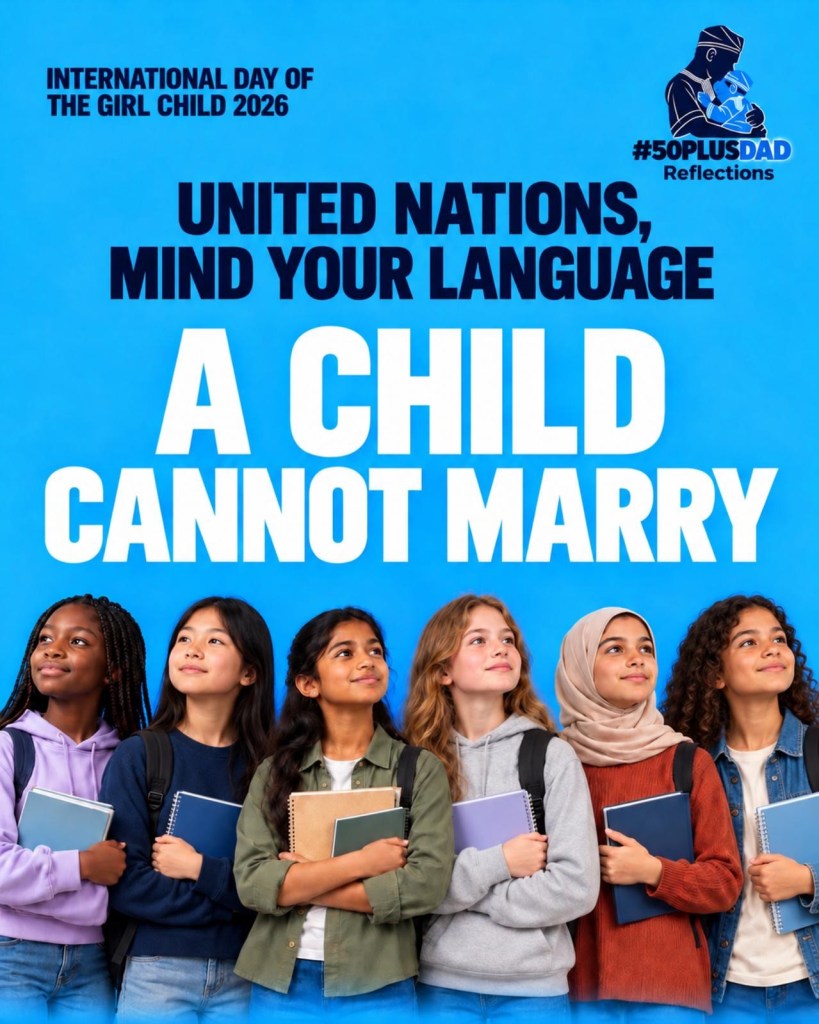
Questioning “End child marriage and invest in girls’ rights!”—the 2026 International Day of the Girl Child theme.
50PLUSDAD Reflections
I hesitated before writing this week’s column.
On 11 October, the world marked the United Nations’ International Day of the Girl Child. This year’s theme was “End child marriage and invest in girls’ rights!”
I support the demand for investment in girls’ rights.
But the first part brought me back to a concern I have raised for years: our language.
I salute the United Nations and the individuals and organisations whose sustained efforts have advanced children’s rights over the years.
My challenge comes from a shared commitment to children’s dignity and well-being.
I am inviting us to examine whether some of our familiar terminology serves that commitment as clearly as it should.
This is not a game of semantics. My argument is that language can misrepresent a violation, minimise its gravity and mask its impact, even when those using it sincerely intend to safeguard children.
That has implications for advocacy: what we call a practice can influence what we ask people to recognise, confront and change.
Can a child marry?
My position is simple: a child cannot marry.
What is commonly called “child marriage” should be named in language that exposes the violation being perpetrated against the child.
I am questioning the description, not denying the existence of the harm.
My concern is that we attach the name of a legitimate social institution to an arrangement that violates childhood.
I have worked in child safeguarding and family strengthening since 1997.
Over these nearly three decades, one of my deepest concerns has been the misconceptions of those who claim to safeguard children.
Abusers bear responsibility for their actions. But what happens when those entrusted with safeguarding use language that, in my view, obscures what the abusers are doing?
Good intentions deserve examination too.
This is a safeguarding concern. Safeguarding encompasses the culture, systems, policies and practices through which we promote children’s welfare and address the conditions that expose them to harm.
Child protection is the focused response when an individual child is suffering, or is likely to suffer, significant harm. It is a component of safeguarding, rather than an interchangeable term.
My challenge concerns the wider safeguarding agenda: the language institutions adopt, the assumptions communities accept and the responsibilities adults exercise.
Where a particular child faces coercion, exploitation or sexual abuse, that responsibility must include a child protection response.
In the first few years of my work, I also used the phrase “child marriage.” But I began questioning it as I examined the language we use about children. Mind Your Language grows out of that longstanding concern.
That examination also shaped my description of harm. I moved from “child abuse” to “abuse of children” to make explicit who is experiencing it. I subsequently began describing that harm as “the dehumanisation of children,” seeking to name its impact in one phrase: the violation of children’s dignity and their treatment as though their humanity, rights and feelings do not matter.
When I use “dehumanisation,” I describe how children are treated. Their humanity and worth remain intact. The violation lies in the conduct of those who disregard them.
That is the same scrutiny I bring to “child marriage.”
Marriage assumes certain essential characteristics, including capacity and free and full consent. My argument is that a child cannot fulfil the requirements of the adult institution we call marriage. Why, then, do we attach “marriage” to what is being done to the child?
Can a chair marry?
Can a car marry?
Calling something a marriage does not give the parties the capacity to enter one.
The description must correspond to the reality.
Consider the distinction between abuse and marriage. Sexual abuse of an animal is not “animal marriage.” We name the abusive conduct; we do not turn it into a marital relationship through our choice of words.
I am drawing a distinction between categories, not equating children with animals or objects.
Why should an adult’s claim, a ceremony or a community’s approval turn the exploitation of a child into “marriage”?
UNICEF uses the term “child marriage” for formal arrangements or informal unions involving someone under 18 and identifies the practice as a human-rights violation.
I recognise the safeguarding intention behind that definition. My challenge is whether the terminology names the harm clearly enough.
When I say that a child cannot marry, I am arguing from the dignity, rights and safeguarding childhood ought to command.
I am not claiming that every legal system already reflects that principle.
I am challenging the legitimacy granted to arrangements that place children in the position of purported spouses.
We must examine capacity, consent and the sexual conduct described as “consummation” within these so-called marriages.
Capacity concerns whether someone can enter the relationship. Consent concerns whether that person freely and knowingly chooses it.
A parent’s approval cannot substitute for the intending spouse’s own free and full consent. International human-rights guidance expressly recognises that requirement.
A ceremony does not answer the question of capacity. A parent’s approval does not answer the question of the child’s freedom. Public celebration does not answer the question of exploitation.
Some defend these arrangements by saying that the child is purportedly “married,” but sexual intercourse will be delayed. That claim must be examined. Even where intercourse is delayed, my objection remains: why place a child in the position of a purported spouse and subject her future to an adult’s marital claim?
Where intercourse occurs, calling it “consummation” must not shield the conduct from scrutiny. That description cannot substitute for an examination of age, coercion, sexual consent and abuse.
In my work, I have encountered girls aged 12 and 13 who became pregnant within these so-called marriages. That experience is part of why I cannot treat this as an abstract disagreement about words.
These are children carrying pregnancies.
WHO reports that mothers aged 10–19 face higher risks of eclampsia, serious infection and other pregnancy complications than women aged 20–24. Their babies also face higher risks of premature birth, low birth weight and severe neonatal conditions.
One devastating injury is vesicovaginal fistula, or VVF: an abnormal opening between the bladder and vagina that can cause continuous leakage of urine. Obstetric fistula typically results from prolonged, obstructed labour without timely medical intervention.
Pregnancy before the pelvis is fully developed is one contributing risk factor, compounded by inadequate access to emergency maternity care. (unfpa.org)
A Nigerian national fistula strategy hosted by UNFPA cites a 2010 review reporting that 93.6 per cent of the Sokoto fistula patients studied had been placed in purported marital arrangements before 18.
In the Kano and Maiduguri patient groups, 81.5 per cent and 52.3 per cent respectively had entered such arrangements by 15.
These are historical findings from particular patient groups, not current national figures, nor the percentage of children in such arrangements who develop fistula.
Behind those figures are girls whose childhoods and health demand our attention.
In my earlier work, I described what such an arrangement can amount to as the legitimisation of repeated sexual abuse of a child. Calling it a marriage can, in my view, dress institutionalised exploitation in the language of respectability.
There is another contradiction to confront.
When an adult sexually abuses a child, we identify the abusive conduct. Where a purported marital arrangement enables repeated sexual abuse of a child, why does “husband” become the defining description?
UNICEF’s own communications use “child bride” and “husband” while explaining and condemning the harm.
My concern is what those descriptions place in the foreground: a purported marital relationship, rather than the child’s dignity and the adult’s conduct.
Whether the adult is male or female, we should identify exploitation and abuse wherever they occur. A ceremony should not confer respectability upon abusive conduct in our vocabulary.
The child remains a child.
I am not alleging that everyone who uses these expressions intends to conceal abuse. My concern is that familiar terminology can carry implications we have not sufficiently examined.
Does our language expose the adult’s conduct? Does it keep the child’s dignity and rights in view? Or does it describe the child as though she has entered an ordinary adult relationship?
The United Nations Committee on the Rights of the Child has acknowledged that expressions such as “child prostitution” can mislead, imply consent and shift blame towards children. INTERPOL recommends language that identifies exploitation and describes the child as persons affected by sexual exploitation.
That is the scrutiny I want us to bring to “child marriage.”
WHO similarly advises against “female circumcision” because it creates a misleading parallel with male circumcision. Its use of “female genital mutilation” emphasises the gravity of the violation, while “cutting” and “mutilation/cutting” also appear in community engagement. The description matters enough to warrant examination.
I also prefer “sexual abuse of a child” to “child sexual abuse.” For me, that wording makes the direction of the harm explicit: abuse is being perpetrated against the child. I advocate that language choice because I want responsibility to remain clearly in view.
We should work towards language that names the coercion, exploitation and abuse involved in placing children in purported marital unions. During that discussion, we can identify “the practice commonly called child marriage” without adopting its claim to legitimacy.
Changing terminology must accompany a broader safeguarding agenda: education, family strengthening, accountable institutions, effective policies and a culture that honours children’s rights. Where an individual child is at risk or experiencing abuse, a child protection response is required.
As a father raising a child, I hear this challenge in everyday expressions too. “Stubborn child.” “Child from a broken home.” How readily we turn a behaviour or a family circumstance into a child’s identity.
Those expressions deserve their own conversations. By God’s grace, I will begin sharing my Mind Your Language project on Thursday, 15 October 2026.
I believe we need a language revolution in our work with children: a willingness to question inherited expressions, examine their implications and choose words that honour children’s dignity.
We can salute decades of committed advocacy while examining the language through which we carry that work forward.
This week, my challenge begins with the girl child.
Let us invest in her rights. Let us build the culture and systems that safeguard her childhood. Let us examine every arrangement that places adult claims above her welfare.
And let us mind our language.
A child cannot marry.
I therefore propose that we call this practice “the institutionalised exploitation of children under the guise of marriage.” Where it involves repeated sexual abuse of a child, we must name that abuse directly.
I offer this description for consideration because our language should expose the violation, identify adult responsibility and uphold the child’s dignity.
Do have an INSPIRED rest of the week with the family.
Follower of Christ. Husband. Father. Egalitarian. Goodwill Investor. Change Agent. Rebel with a Cause. Attorney. Author. Thriver. Culture-Led Family Strengthening and Child Safeguarding Pioneer, Innovator and Practitioner. Value-Based Parenting Ideologue. Three Decades in the Saddle.

