HomilyFromthePew
There is a discipline I have developed over thirty years of frontline work. It is the discipline of looking beyond the surface; of thinking end to end; of refusing to be seduced by the announcement, and asking instead: where does this end?
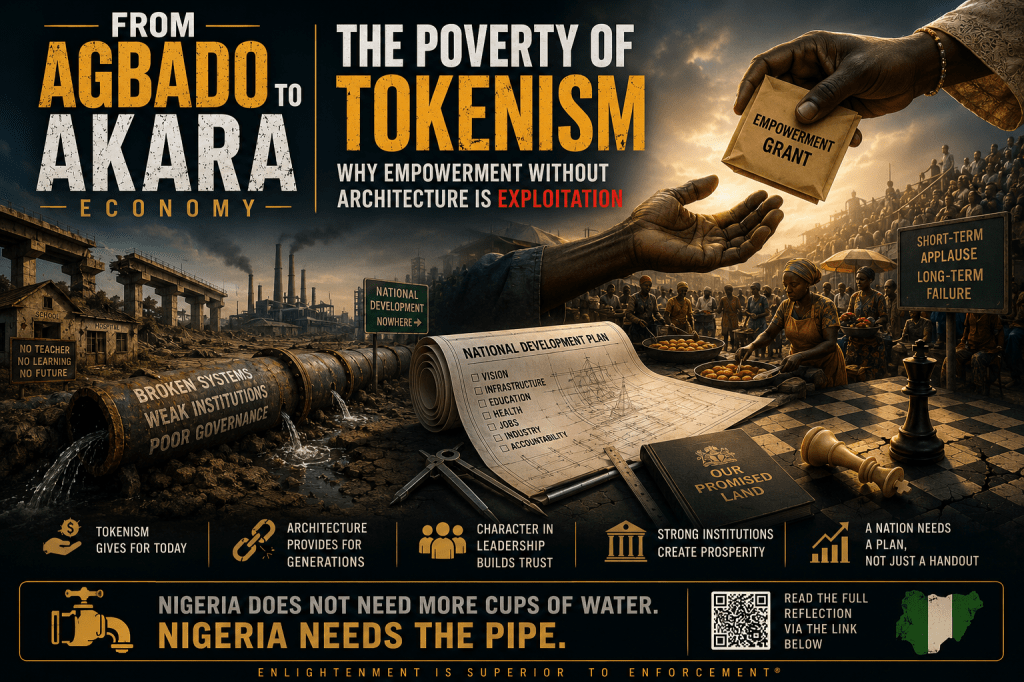
It is in that spirit that I wish to address a matter that has occupied the national conversation: the public display of large-scale financial benevolence by Nigeria’s First Lady toward aspiring small business owners.
I do not come to this discussion to name names or to assign blame. I come as an egalitarian; as someone whose governing conviction is that Enlightenment is Superior to Enforcement®; as someone who believes that the most dangerous poverty is not the poverty of the pocket, but the poverty of the framework.
Let us begin with the facts.
THE FACTS ON THE GROUND
According to Nigeria’s National Bureau of Statistics, in collaboration with UNDP, UNICEF, and the Oxford Poverty and Human Development Initiative, 133 million Nigerians, representing 63% of our population are multidimensionally poor. This is not a figure drawn from opposition press releases. This is the government’s own data, published in 2022.
Multidimensional poverty is not merely about income. It measures deprivations across health, education, water, sanitation, housing, and cooking fuel. It tells us not just that people are poor, but how comprehensively poor they are.
The intensity of those deprivations stands at 52.9%. That means the average poor Nigerian is deprived in more than half of the indicators of human well-being simultaneously. Among children aged 0 to 17, the figure is even more devastating: 67.5% of Nigerian children live in multidimensional poverty. Half of all poor Nigerians are children.
Over the past decade, Nigeria’s GDP per capita has fallen by over 74%, from $3,222 in 2014 to $835 in 2025, a figure the IMF has confirmed as the lowest in recorded history. Under the APC administration, the nation fell into two recessions within five years. GDP growth, which once averaged above 6% under previous administrations, collapsed to near zero. Nigeria, once Africa’s largest economy, now ranks fourth on the continent, after being overtaken by South Africa, Egypt, and Algeria, nations with smaller populations but more disciplined economic architecture.
Economists are clear: Nigeria requires at least 8% to 10% annual growth to meaningfully reduce poverty and absorb its rapidly expanding workforce. At the current trajectory of 3% to 4%, we are not growing. We are, at best, maintaining. And given our population growth rate of approximately 2.6% annually, maintaining is another word for falling behind.
Meanwhile, Nigeria’s total public debt has risen from ₦12 trillion in 2015 to over ₦97 trillion as of early 2025. Debt servicing alone now consumes nearly 75% of government revenue. Even the 2024 budget allocated more to debt repayment than to health, education, and infrastructure combined.
As for the National Assembly, the institution constitutionally mandated to appropriate with wisdom and oversight, civic-tech organisation BudgIT revealed that over 11,000 projects valued at ₦6.93 trillion were inserted into the 2025 federal budget by lawmakers, many of them with no geographic identifier, no design, no clear mandate, and no mechanism for public accountability.
These are not investments in national development. These are instruments of political self-preservation, funded by the people they fail.
THE QUESTION THAT MUST BE ASKED
Now, into this context steps a gesture of financial distribution to small business aspirants.
And the nation divides: some applauding, some condemning. Both sides, I submit respectfully, are missing the point.
The question is not whether small businesses matter. They do.
The question is not whether the gesture is generous. It may well be.
The question, the only question that is analytically honest is this:
Is this a policy, or is this a performance?
No nation has ever been developed by tokenism. Not Japan. Not Singapore. Not the United Arab Emirates. Not China.
These nations did not merely distribute money to individuals. They built architecture. They articulated a vision. They aligned their institutions. They demonstrated altruism at the leadership level not merely in gesture, but in lifestyle, sacrifice, and the subordination of personal interest to national purpose.
The builders of Singapore and the UAE did not amass personal wealth while their nations struggled. They embodied the covenant between leader and led.
Social investment is not charity. It is policy.
The International Labour Organisation has established that the solution to endemic child labour, one of the most visible symptoms of poverty is social protection. Social protection is a function of deliberate, sustained, systemic social investment.
Not a one-time disbursement.
Not a headline.
“A king gives stability to a land by justice, but a man who takes bribes overthrows it.” (Proverbs 29:4)
WHAT GENUINE EMPOWERMENT REQUIRES
Genuine empowerment of the Nigerian people requires, first, the character of those in leadership.
Not their public persona.
Their character.
Their antecedents.
Their demonstrated heartbeat for the people they govern.
The Nigerian Constitution is unambiguous in Section 14(2)(b): the security and welfare of the people shall be the primary purpose of government.
Not a secondary consideration.
Not a campaign strategy.
The primary purpose.
Second, genuine empowerment requires a leadership philosophy grounded in social contract; in the understanding that governance is not an opportunity for personal accumulation, and that public trust is not a commercial franchise.
Third and this is perhaps the most urgent deficit Nigeria requires a defined national development plan with clear milestones, transparent indicators, measurable timelines, and sovereign accountability.
Not sector-by-sector press releases.
Not project launches without completion.
Not budgets without implementation reports.
A plan.
A vision.
A promised land that can be located on a map.
When a government distributes money to citizens in isolation from all of these things, it is not empowerment. It is inducement.
And inducement, however generous is the enemy of liberation.
We have seen it in elections: money given to voters is not investment in the voter’s future. It is the purchase of the voter’s silence.
“For I know the plans I have for you, declares the Lord, plans for welfare and not for evil, to give you a future and a hope.” (Jeremiah 29:11).
A WORD TO BOTH SIDES
To those who celebrate this gesture without interrogation: your loyalty to persons in power is understandable. But loyalty without analysis is not patriotism. It is participation in the problem.
Ask the hard question.
Where is the plan?
Where is the architecture?
Where are the measurable outcomes?
To those who condemn this gesture without engagement: your anger may be legitimate. But anger without a framework is only noise.
What do you propose?
What does a national development plan look like in your view?
What does genuine social investment require?
Become the alternative you are demanding.
To both: Nigeria does not need more heat. It needs more light.
THE VERDICT
133 million people in multidimensional poverty.
A GDP per capita that has fallen 74% in a decade.
A debt burden that devours 75% of government revenue.
A National Assembly that inserts trillions in untraceable projects into annual budgets.
These are not partisan statistics. These are the government’s own numbers and the published findings of institutions that cannot be accused of political bias.
In such a context, what is tokenism?
Tokenism is the art of responding to a systemic crisis with an individual gesture and calling it transformation.
It is the equivalent of offering a cup of water to a man dying of dehydration, without building the pipe that would have kept him hydrated all his life.
Nigeria does not need more cups of water.
Nigeria needs the pipe.
The pipe is a national vision. A national mission. A measurable development plan. Political leadership that is not for sale and is not selling itself. Institutions that are accountable. Budgets that are transparent. A National Assembly that appropriates for the nation, not for itself.
Until we have these things, every gesture, however well-funded is not empowerment. It is the management of poverty.
And the management of poverty, however compassionate it appears, is the perpetuation of poverty.
“Learn to do good; seek justice, rebuke the oppressor; defend the fatherless, plead for the widow.” (Isaiah 1:17).
We are better than this.
We must demand better than this.
And demanding better must begin with knowing the difference between a gesture and a plan; between an inducement and a covenant; between tokenism and transformation.
Do have an INSPIRED week with the family.

