As a minister in the Ministry of Clarity, I have seen life for close to six decades, nearly three of them as a family attorney. I have chosen to watch from the pew, never wearing the cassock. The pew offers a clear view of the bench: not the judge’s bench, but the bench facing the pulpit.
From that seat, this is my conclusion: none of us ever has enough data to judge another person. We do not even have enough data to judge ourselves. As Paul put it, “I do not even judge myself” (1 Corinthians 4:3).
By judgment, I mean appointing ourselves the final authority over another person’s life.
Consider judicial discretion. The law gives judges discretion because life is rarely black and white. Even judges, who hear both sides, must rely on it, and how they feel, why they feel it and what is happening around them can influence their decisions. Hearing both parties still does not give anyone complete data.
What, then, of us when we pass judgment online?
First, we lack patience.
Gathering data requires sitting down, listening, empathising, checking again and triangulating. Many times, when we rush to judge, we are not interested enough to do that work. We simply want to say something.
Second, we lack access.
Even with patience, the best data lies with the people concerned. But we have no relationship with them. The people concerned do not owe strangers access to their private lives.
So what fills the gap?
“Dem say, dem say.”
Borrowing the language of locus standi, what is our standing in the matter? No one simply walks into court; the first question is, what is your interest? Yet on social media, we appoint ourselves judges, without standing, without access and without data.
“But he is a public figure. We are demanding public accountability.”
Does public accountability dispense with protocol, due process, decorum, order and proper human conduct?
Whatever our interest, once pursuing it requires violating those standards, that interest becomes suspect.
Borrowing another business expression, consider “limited liability.” A shareholder’s liability is limited to their stake in the company: they answer for what is theirs, not for everything. Let us apply that principle here. Our involvement should be limited to what is ours. So what is our stake? What do we enjoy, and what do we suffer?
Consider who bears the consequences. An employee comes with a certificate. If the company collapses, the employee can dust off that certificate and seek another job. The owners cannot simply dust off the certificate of incorporation. They bear the loss of what they built and must work out what comes next.
Now, what is our stake in the lives we are judging?
We do not carry the consequences of their lives. Whatever happens, we eat, go to work and continue our lives.
Are we concerned, or merely meddlesome interlopers?
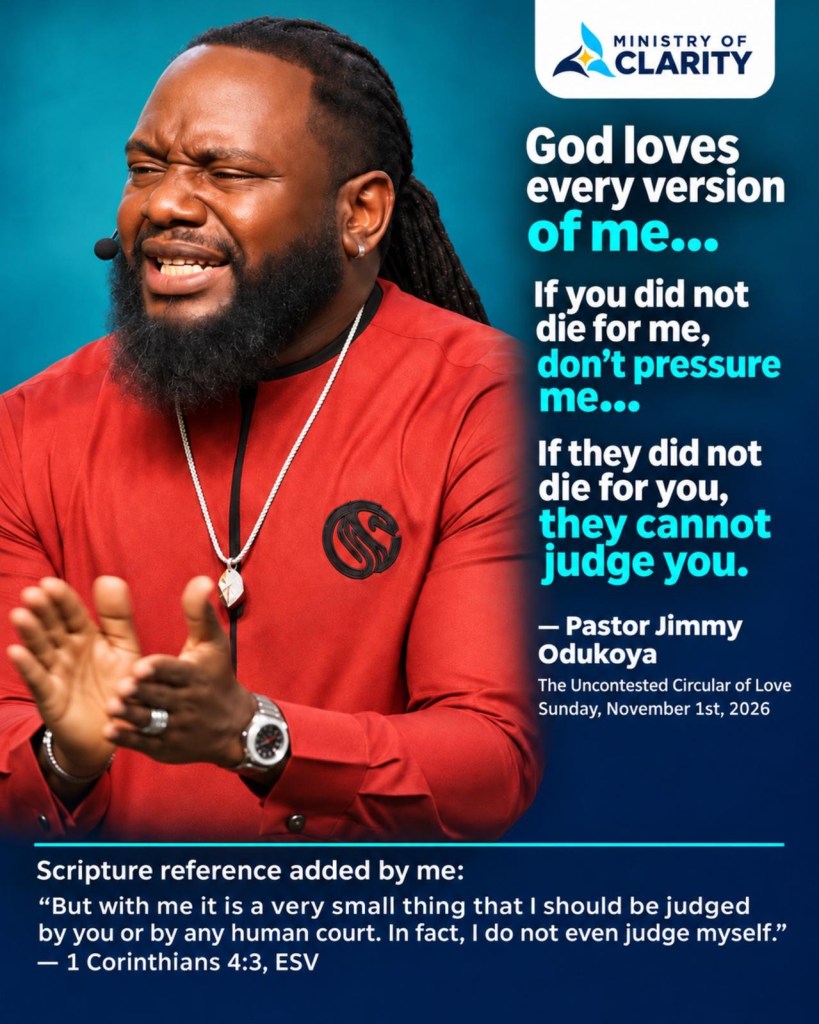
As Pastor Jimmy Odukoya said on Sunday, if they did not die for you, they cannot judge you.
I would take it further. Even the One who died for us does not condemn us.
“For God sent not his Son into the world to condemn the world; but that the world through him might be saved” (John 3:17).
“Who is he that condemneth? It is Christ that died… who also maketh intercession for us” (Romans 8:34).
Think about it. Jesus has the highest stake in our lives. He paid the highest price: He died. Yet He does not stand over us pronouncing verdicts. He stands at the right hand of the Father, interceding for us.
If the One with the greatest stake does not condemn us, who are we to condemn anyone?
No matter how strong our interest, no matter how loud our opinion, we did not die for them.
Those who truly know people do not judge them. They love them. That is God’s own disposition towards us: He loves every version of us.
Even when a matter concerns us, our interest does not give us complete knowledge of another person.
I know this couple. I celebrate Pastor Jimmy and Pastor Mo Odukoya’s marriage wholeheartedly. I know whom I am celebrating.
God alone has complete knowledge. Let God be the final Judge.
Whichever side we stand on, when we appoint ourselves judges over others, we are wrong. Judging is an exercise in futility. Anywhere we turn, when we judge, we fall.
No data, no judgment.
Enlightenment is Superior to Enforcement®
Follower of Christ. Husband. Father.
Egalitarian. Goodwill Investor. Change Agent. Rebel with a Cause. Attorney. Author. Thriver. Culture-Led Family Strengthening and Child Safeguarding Pioneer, Innovator and Practitioner. Value-Based Parenting Ideologue. Three Decades in the Saddle.

